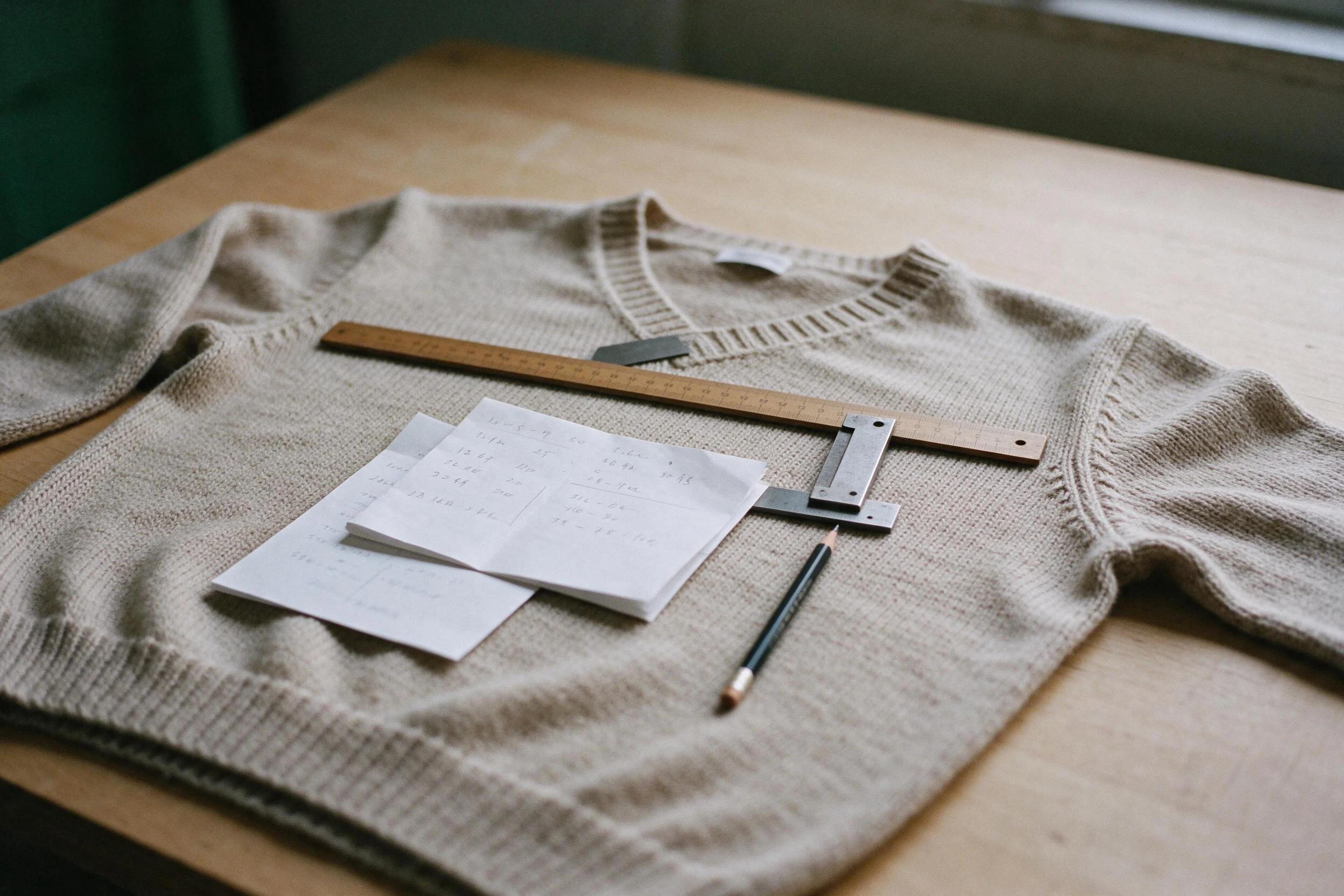
A body, a ruler, a square of paper and a scale. Four of the five numbers below can be taken off this garment without a machine in the room; the fifth needs a pair of hands.
The machinery news this month is loud and none of it will appear on a rail. A flat-knitting group is pushing into new markets with its latest design software; the industry gathered in Shanghai in the third week of November for ITMA Asia + CITME; warp-knitting mills are talking about a fourth dimension of their fabric. It reads as engineering, but it lands on the shop floor two seasons later as a change in what a buyer is allowed to ask for.
So it is worth writing down the opposite discipline: what you can read off a finished knitted garment with nothing but a ruler, a scale and two hands. Five numbers. Every one of them is already inside your quotation before anyone has spoken to a factory — and if you know them, the first conversation stops being about price and starts being about the garment.
One: density — wales and courses per 10 cm
Lay the garment flat, mark 10 cm across the chest, and count the vertical columns of stitches (wales) and the horizontal rows (courses). A pick glass makes it easy; a phone camera on macro and a ruler gets you close. Density is the number that tells you which machine made the cloth, and the machine is the biggest single term in the price.
For plain jersey, the bands look roughly like this: a 16GG fine knit reads 55–62 wales and 70–80 courses per 10 cm; a 12GG knit, 40–45 wales and 52–60 courses; a 7GG, 26–30 wales and 34–40 courses; a 3GG chunky, 10–13 wales and 14–18 courses. Ribs, cables and jacquards move those counts — a 2×2 rib pulls the wales together, a cable panel gathers the ground — so measure a plain area, not a panel.
What it decides. The gauge, the yarn count that fits it, and the floor of the per-piece price. Fine gauge means more stitches per centimetre, therefore more machine time per square metre, therefore a higher piece price and a lower yarn bill; coarse gauge is the reverse. It also decides whether the silhouette you drew is available at all: a fluid, heavy-falling column dress is a 16GG or 18GG garment, and no amount of styling will make a 7GG body fall that way.
Where it bites. Two lots of the same yarn count can knit 2–3% denser, which shows up as a garment 1–1.5 cm narrow at the chest after it has been quoted from a sample knitted with the first lot. And if the two lots land in the same order, the join between body and sleeve reads as a step in the surface even though both panels are the correct width. This is why we ask for a density with a tolerance rather than a density.
Two: weight — grams per square metre
Cut a 10 × 10 cm square out of a seam allowance or a hem facing, weigh it on a scale that reads to 0.01 g, and multiply by 100. That is your cloth weight in g/m². It takes four minutes and it is the number most often missing from a tech pack.
Bands we work in: 150–190 g/m² for fine-gauge summer jersey and crepe, 220–280 g/m² for a standard winter jumper body, 300–380 g/m² for a heavy knit or a brushed surface, and 420 g/m² and up for a coatigan or a 3GG overshirt. Brushing and fulling add surface weight after knitting, so a brushed style can come out 8–15% heavier than the greige panel it was quoted on — quote the greige, then allow for finishing.
What it decides. The yarn bill, directly. A body of 0.62 m² at 240 g/m² takes about 150 g of yarn; add 8–12% for waste, multiply by the yarn price, and you have the largest variable cost in the garment. It also decides whether a style belongs in a spring drop or a winter one, and how it hangs. A 10% weight error is roughly one size of drape, and a summer knit that arrives at 300 g/m² is a winter knit at a summer price.
Where it bites. At the finishing drum and at the dye house. Two bulk lots of the same yarn, same density, can end up 5% apart in finished weight after washing and tumble-drying, which is invisible on a spec sheet and obvious on a rail.
Three: rib recovery
Mark 10 cm on the neckband, the cuff or the hem band. Stretch it to 18 cm, hold for ten seconds, release, and measure again after one minute and after 24 hours. A rib that comes back to 10.1–10.4 cm is doing its job. One that settles at 10.6–11.0 cm is marginal. One that stays at 11.5 cm or beyond will grow on the customer, and the first place you will see it is the neckline.
What it decides. How long the garment looks new, and therefore whether it is a reorder. Three things move the number: the elastane content, the rib structure (a 1×1 recovers differently from a 2×2 of the same width), and the number of courses in the band. Two more courses and 2% more elastane is a small cost at the knitting stage and an impossible one to add after bulk.
Where it bites. On the table, everything measures correctly. The neckband is 17 cm, as specified. It is on the fifth wear, after the garment has been pulled over a head five times, that it measures 19 cm — and by then the only fix is a new rib programme.
Four: the seam — type and stitches per inch
Turn the garment inside out and look at the shoulder and the armhole. A linked seam (what we call stitching on the linking machine, 6–8 stitches per inch on a 12GG, 4–5 on a coarse gauge) is a chain of loops that follows the stitch columns; a four-thread overlock is a cut-and-sew seam; a flatlock is a flat join with the seam allowance laid open across the inside. Count the stitches over an inch of seam and you have the second half of the construction story that density started.
What it decides. Whether the garment can be fully fashioned or has to be cut from panels, which is the difference between a seam that is a design detail and a seam that is a cost. It also decides how the garment behaves under load at the armhole, which is where every knitted garment is asked to do the most work.
Where it bites. A linked seam with too few stitches per inch grins open at the armhole when the wearer raises an arm, and no amount of pressing closes it. A seam allowance 2 mm too wide eats the innermost narrowing mark, so the edge that was supposed to read hand-finished reads plain. And a flatlock on a soft, brushed yarn corrugates the edge into a ripple that cannot be pressed out.
Five: the edge — depth in courses, and how it is closed
Measure the neckband, the cuff and the hem band in centimetres, then in courses. A 12GG neckband at 2.5–3.5 cm is 12–18 courses; a hem band at 6–8 cm is 30–40. Then look at how it is closed: knitted-in, linked, turned and stitched, or bound with tape. This is the last 3 cm of the garment and the part buyers unconsciously price the whole thing on.
What it decides. Yarn consumption and labour, in that order. A 12 cm-wide body uses 15–20% more yarn at the hem band than a plain hem of the same garment, and a band that is linked rather than turned is a separate operation. It also decides whether the edge stays straight: an edge knitted in the same yarn as the body recovers with the body; an edge on a separate, firmer yarn stops recovering with it. Our notes on the five edges go through this one edge at a time.
Where it bites. A wavy cast-on that flattens after two washes and never comes back; a hem band that flares because the band has more stitches than the body can hold; a label slot cut after knitting, which leaves a raw edge on the inside of the most-touched part of the garment.
The five, side by side
| Number | How to read it | What it decides | Cost of getting it wrong |
|---|---|---|---|
| Density | Wales and courses per 10 cm on a plain area | Gauge, yarn count, piece price floor | 1–1.5 cm narrow at the chest; surface step at the join |
| Weight | 10 × 10 cm square, weighed, × 100 | Yarn bill, season, drape | 10% is one size of drape; a summer style at winter weight |
| Rib recovery | 10 cm stretched to 18 cm, measured after 1 min and 24 h | Neckline and cuff life; reorder potential | Neckline 1–2 cm larger by the fifth wear |
| Seam | Inside out: linked, overlock or flatlock; stitches per inch | Fully fashioned or cut-and-sew; armhole behaviour | Seam grin; narrowing chain eaten by the allowance |
| Edge | Band depth in cm and courses; how it is closed | Yarn use, labour, whether the edge stays straight | Flared hem; wavy cast-on; raw label slot |
What the machinery news actually changes
Three things are moving at once in the trade press, and they are worth a comment because they change the menu rather than the arithmetic. Flat-knitting software has become the real product: programming a shape, a pocket and a stitch structure in one file is now a design-room activity rather than a machine operator's skill, and the machine makers are selling it into new markets — India among them — on that basis.
Second, whole-garment work keeps appearing in places that used to be cut-and-sew. One warp-knitted vest shown this month is knitted in one piece, with the pockets built into the fabric — no cutting, no sewing. It is a sports piece rather than a fashion one, but the direction is clear: one-piece construction is moving from novelty to an option a mid-size programme can quote.
Third, the warp-knit mills are competing on stability and function rather than on surface. That is the structural point we have made before and it has not changed: warp knits hold the width the beam gave them, weft knits can be shaped stitch by stitch. If a reference needs both a dense, clean-cut edge and a shaped waist, it is two garments.
Our reading of all this is unfashionable. The machinery makes more shapes possible; it does not make a bad number good. A one-piece garment still has a density, a weight, a rib recovery, a seam — or an absence of one that has to be programmed — and an edge. Whole-garment work removes the seam and adds programming hours, and it removes your last chance to correct the garment after knitting. On a 300-piece order that trade is usually not worth it; on a 60-piece capsule with a story, it often is.
Three styles we can develop from these numbers
All three are on the rails or in the trade press this season, and all three are readable through the five numbers above. What follows is what we can develop, and what we would warn you about before you commit.
- A whole-garment funnel neck with a knitted-in pocket. 12GG or 14GG, 240–260 g/m², rib recovery at the neck around 10.3 cm, and no side seam to correct after knitting. We can program it and knit it; the cost is in the programming, and the risk is that any measurement error is permanent. Budget one extra sample round.
- A brushed 3GG coatigan with a narrowed raglan. 420–520 g/m² finished, so the yarn bill is the quotation. The narrowing chain has to stay visible on the outside of the raglan or the style loses its reason; brushing happens after knitting and adds 8–15% surface weight, so the greige weight has to be agreed before the price is fixed.
- A 16GG double-face shell with a clean cut edge. 55–62 wales per 10 cm, 190–210 g/m², a flatlock join and an edge that is bonded or bound rather than knitted. This is the fine-gauge piece that reads expensive in a photograph and is the most sensitive of the three to density drift between yarn lots.
Counting a garment is not copying it — where the line is
Everything above is measurement, and measuring a garment you bought is ordinary practice in this industry. The line sits a short step further on, and it is worth stating plainly because buyers cross it by accident more often than by intent.
- A garment you own can be measured. Density, weight, rib recovery, seam, edge — take all five, and we will work from your numbers. That is how a reference becomes a brief.
- A technical drawing or pattern file belongs to whoever made it. If a document came from another supplier, we will not knit from it, and we will not accept it as an attachment.
- A jacquard repeat, an embroidery artwork, a logo: protected. Redrawing a motif 20% differently is not a defence, and a recognisable motif from a brand's lookbook does not enter our sample room.
- Registered designs exist. A recognisable commercial shape can be registered for a period in several markets. Before a near-copy goes to sample, an afternoon of checking is cheaper than a letter.
- A photograph is a photograph. Send a lookbook image as a direction, and we will draw our own panel and our own numbers. Send it as a specification and we will send it back.
- Keep the record dated. Your sketch, our diagrams, the swatch you approved. If a question arrives two years later, a dated folder answers it in ten minutes.
What to send, and what comes back
Send the five numbers, or send the garment and we will take them. Add the yarn if you have one, or the swatch you are trying to match, and say which of the numbers is negotiable — density, weight and rib recovery almost never are; edge depth usually is.
Within three working days you get back a one-page sheet: the gauge and yarn count we would use, the density and weight we will knit to with tolerances, the rib programme with elastane percentage, the seam type at each join, and a yarn bill in grams per piece. That sheet is what a quotation should be built on, and it is the same sheet we will measure bulk against.
The one number to take first
Density. It tells you the machine, the machine tells you the yarn, and the yarn tells you most of the price. Weight is second, and it is the difference between a quote that holds and one that does not. The other three decide whether the customer comes back.
Three questions we get asked
Can you match the density of our reference exactly?
On the same yarn, to within about 5% — that is what a tolerance is for. On a different yarn, we can match the hand-feel or the density, but rarely both to the decimal: a yarn with more twist knits denser at the same gauge, and a softer yarn knits looser. Tell us which of the two matters more and the answer becomes exact enough to quote.
Our sample weighed 240 g/m² and bulk feels thinner. Why?
Usually one of three things: a yarn lot with a slightly different count, a finishing route that was shortened to hit a date, or a density that drifted a few percent on a different machine. All three are measurable, and the fix is decided before the next lot — a re-weighed square and a re-counted 10 cm will tell you which of the three it was.
Is it a problem that our reference is a competitor's garment?
No, if it is used as a measurement. Measure it, count it, weigh it, and bring us the numbers with your own sketch. Yes, if the plan is to reproduce it — a pattern file, a jacquard repeat or a logo we do not have the right to use. The difference between the two is a conversation we would rather have at the start.