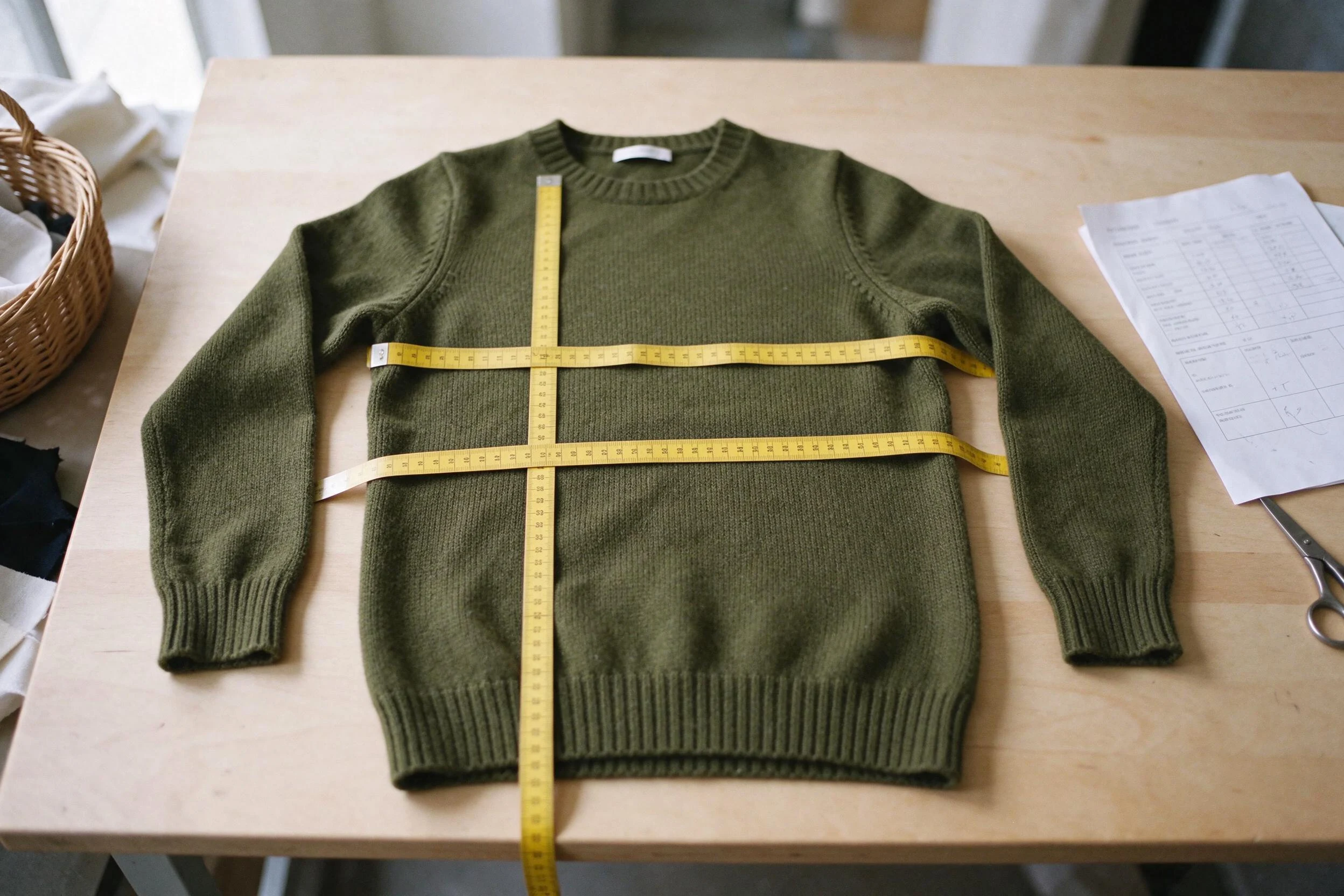
A garment on the measuring table, relaxed, with the chart beside it. Almost every fit dispute is decided in the gap between those two objects — and it is usually a question of where the tape started, not of what the machine did.
The measurement chart is the one page of a tech pack that both sides read literally. A studio measures a garment flat on a table, straight out of the bag. A factory measures it flat on a table, four hours later, after the panel has relaxed. Both numbers are honest. They are not the same number, and neither of them is wrong.
So the useful thing is not a longer chart. It is five measurements taken the same way on both sides — chest, body length, sleeve, shoulder and neck, and the rib bands — and, next to each, the amount it is allowed to move before anyone has to call it a fault. Below is each one: where it is measured from, how far it can drift, and what in the making moves it. Then where a graded chart breaks, and the season's two opposing proportions, which pull the same chart in opposite directions.
A knit is measured twice and quoted once
Every measurement we quote is a relaxed flat measurement: garment closed, on a table, after at least four hours of rest, with a tolerance of ±1cm unless the chart says otherwise. The stretched measurement is a different number and belongs to the fitting, not to the chart. A 2×2 rib at the hem can be pulled 4–6cm wider than it rests; a fine jersey across the chest can be pulled 6cm without much effort. A buyer feels the second number, the factory is asked for the first, and both are true.
That is why the tolerance column matters more than the measurement column. A chart of ±1cm on a garment graded in 5cm steps has a fifth of a size of slack built in, and that slack is what absorbs the difference between a studio's table and ours. A chart with no tolerance is not a stricter chart; it is a promise that will fail inspection on something that is not a fault.
One: chest, measured flat
Across the garment, 2cm below the armhole, side seam to side seam, front closed. On a seamless or fully-fashioned body there is no side seam, so we mark a reference point with a pin, hung from the shoulder, and photograph it into the tech pack — otherwise the studio and the sample room are measuring two places 1cm apart and neither of them is lying.
Where it moves without anything being wrong. A 1×1 rib body pulls in 2–3cm at rest and gives it back on the body; a Milano or a double-face holds its width almost exactly; a brushed lambswool relaxes 1–2cm after the first wash. Cost. On a jacquard body the chest is fixed by the needle count of the panel, so a 2cm change is a program change, not a sewing change — the same 2cm that is free on a cut-and-sew body.
How it goes wrong in bulk. The garment is measured straight off the press, still carrying moisture, and reads 1cm wide. Bulk passes; the buyer measures it dry a week later.
Two: body length, and the two places it starts
Body length is measured from the high point of the shoulder at the neck, straight down to the hem edge. On a set-in shoulder that point sits on a seam. On a drop shoulder the seam is 6–10cm out along the arm, and if it is used as the reference, two garments of identical length read 3–6cm apart. This is the single most argued number I see between a studio and a factory, and it is not a disagreement about the garment at all.
Then the hem itself. A ribbed hem recovers, a plain hem rolls, and both move after wash. A 2×2 rib with 2–3% elastane comes back to within 1cm; a cotton rib without elastane can gain 2–3cm of length over ten washes and never give it back. If the chart was set on a sample measured before wash, the number that ships is not the number that was approved — and nobody notices until the second bulk.
Our practice: on any style with a rib deeper than 6cm, the wash trial is measured and both numbers go on the chart, before and after. The second one is the garment the customer will actually own.
Three: sleeve length — three different measurements
There are three conventions and they are not interchangeable:
- Shoulder point to cuff — the set-in sleeve number, and the one most charts assume.
- Centre back neck to cuff — the raglan number, and the one that matches how a raglan is actually knitted.
- Underarm to cuff — what a factory needs to set the sleeve program, and what a fitter never asks for.
On a drop-shoulder style, the measurement from the shoulder point includes 6–10cm of body. Comparing two suppliers who use different conventions, one sleeve will look 8cm shorter with no difference in the garment — and one of those suppliers will be asked to add 8cm it does not need.
Sleeve length is also the measurement most affected by gauge. At 3GG a course is roughly 2cm of length, so a two-course programming difference moves the cuff by ±4cm; at 16GG a course is a few millimetres and the same error is invisible. Coarse gauge deserves a wider tolerance: we write ±1.5cm at 3GG–5GG and ±1cm above that. Anything tighter is a number nobody can hold on a brushed yarn.
Four: shoulder and neck
Two numbers that fail in opposite directions. Shoulder width is taken across the back, armhole to armhole at the seam line. Neck width is taken across the neckline at its widest, closed, and it is the one that quietly opens after a month of wearing: a neckband knitted with too few courses of rib can measure correctly on the table and give up 1–2cm of recovery after five wears. Recovery comes from courses and from the rib structure, not from elastane added at the last minute.
On a knit a shoulder is not a seam holding a shape, it is a slope. We knit 8–14 courses of shoulder slope depending on gauge; a shoulder knitted flat and pressed into position looks correct on the hanger and rises the moment it is worn. That is decided in the program, not on the finishing table, and it belongs in the tech pack beside the chest number.
Five: hem and cuff ribs
Rib is the part of a knit that does the work, and it is usually specified by depth alone. What actually decides recovery is three things: the rib ratio, the elastane content and the number of courses. Our defaults are unglamorous and they hold up:
- 2×2 rib, 2–3% elastane, 7–10cm deep — for a hem that has to carry the weight of the body without flaring.
- 1×1 rib, no elastane — for a soft hem where recovery is not the point and a little growth is acceptable.
- Deep rib body, 10–12cm — this season's cropped shapes. More elastane, not less, because a shorter body puts more strain on the same band.
Cost note: elastane is a small line item, the rib is not. A 12cm rib body consumes 15–20% more yarn at the hem, and on a cropped cardigan that is most of the garment's yarn bill. It is also the reason a cropped style quoted cheaply is usually a cropped style with an 8cm rib.
The five, side by side
| Measurement | Measured from | Allowed drift | What moves it |
|---|---|---|---|
| Chest, flat | Side seam to side seam, 2cm below the armhole, front closed | ±1cm | Rib structure, gauge, relaxation after wash, press moisture |
| Body length | High point of shoulder to hem — state the point, and whether the rib hangs | ±1cm; ±1.5cm at 3GG–5GG | Reference point, rib recovery, wash, whether it was measured before or after |
| Sleeve length | Shoulder point, centre back neck, or underarm to cuff | ±1cm | Measuring convention, gauge courses, cuff rib depth |
| Shoulder and neck | Armhole to armhole across the back; neckline at its widest, closed | ±0.5–1cm | Shoulder slope in the program, neckband courses, rib recovery |
| Hem and cuff rib | Depth of the band, and width at rest | ±1cm | Rib ratio, elastane percentage, yarn, courses |
Two proportions on the rails at once
This season the rails carry two shapes that pull the same chart in opposite directions. One is the short, square body — 42–46cm length, a 10–12cm rib, worn over something longer. The other is the long, narrow column — 68–76cm, no rib, a fine gauge tube. Both are usually graded from one base block by studios that rarely make both.
The cropped square body is easy to knit and hard to measure. The rib is a quarter of the garment, so every error in the rib is amplified; the body length has to be specified from the high point with the rib hanging, not pulled flat, or the garment arrives 2cm short of its own chart. The long column has the opposite problem: the gauge has to be fine enough that the garment does not weigh too much at 70cm, and the hem will grow unless there is a small rib or an elastane cast-off.
Where I see these fail commercially rather than technically is in the second bulk. A cropped cardigan is set at an 8cm rib because that is what the sample had; bulk is produced at 10cm to save yarn; the garment is 2cm shorter than the chart, the fit changes, and the fault is recorded against the factory that followed the new instruction.
Where a graded chart breaks
Three places, in the order they turn up:
- The rib at grade. Rib ratios do not grade evenly. A 2×2 rib needs a size step divisible by four stitches, so steps of 4–5cm at the hem rather than the 5–6cm used at the chest. Force a 3cm step onto a 2×2 rib and the panels stop matching at the side seam.
- The motif repeat. A jacquard or an intarsia block divides at some sizes and not others. Either the motif scales — a program per size — or it holds and gets re-placed, which leaves more ground at the edges on the large sizes.
- The needle bed at the largest size. A body that fits one bed at S may need splitting at XL. That adds a centre seam, changes the reference points on the chart, and it is cheaper to discover before the size run than during it.
How we hand a chart over
Four things travel with every quotation, and they are the four that decide whether a bulk measures the same as a sample:
- A measurement chart with a tolerance column, in the tech pack, before the price — not after the sample.
- For ribbed styles, wash-trial measurements before and after, both on the chart.
- Reference points marked on the approved sample with a pin or a stitch marker, and photographed: chest, body length, sleeve convention.
- Bulk measured on dry, rested garments — 5 pieces per size or 10%, whichever is greater, at AQL 2.5.
None of this is difficult. All of it is cheaper than a second bulk, which is the alternative way of learning the same five numbers.
Five numbers to put in the tech pack
Chest, measured flat. Body length from the high point of the shoulder, with the rib hanging. Sleeve length, with the convention named. Neck width, closed. Rib depth and elastane percentage. Add a tolerance of ±1cm to each and you have removed most of the reasons a knit gets measured twice and believed once.
Three questions we get asked
My sample measured right and the bulk reads 2cm short. What happened?
Usually one of three things, in this order: the sample was measured dry and rested, the bulk straight off the press; the sample's rib was measured hanging and the bulk's pulled flat; or the reference point for body length moved from the high point to the shoulder seam between the two. All three are measurable, and we ask for the photographs that show the tape in place before we adjust anything on the machine.
Can a knit be graded like a woven?
No, and the reason is mechanical rather than commercial. A woven body grades by re-cutting a pattern; a knit body grades by adding stitches, and the stitches have to land in a panel that the bed can still produce. Rib has to divide, a motif has to divide, and at the top of the size range the panel has to fit the needle bed. That is why knit size steps are usually 4–5cm and why the largest size sometimes carries a seam the smaller ones do not.
Which number goes on our product page?
The relaxed flat measurement, with the tolerance, and with the measuring convention stated — body length from the high point, sleeve from the shoulder point. It is unexciting copy, and it is the only version that will not generate a return from a customer who measured their own garment with a tape and a mirror.