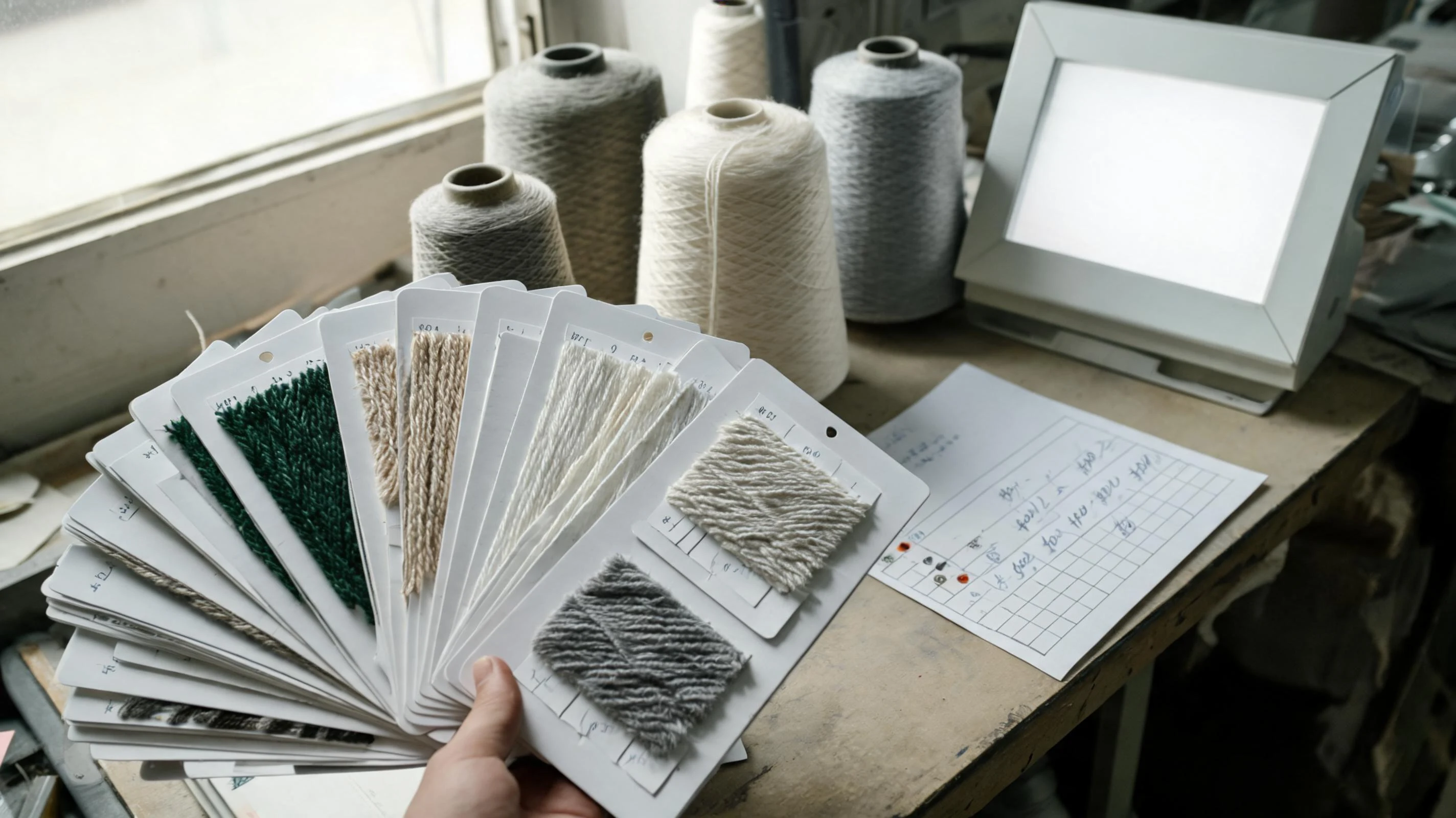
A colour bench in the sample room: dyed yarn cards in one family, the cones they came from, and the light box the shade gets checked under.
Most knitwear buyers meet colour as a number on a tech pack. By the time that number reaches us it has already become a decision about which yarn to buy, in which dyelot, knitted on which machine, and pressed at which temperature — and every one of those steps can move the shade a little further away from the card.
This note walks through the five decisions that actually determine whether a colour survives an order. It is written from the sample room, not the trend deck: what we can control, what we need from you, and where the money goes when a shade has to be re-dyed.
Why colour on a knit is decided early
On a woven shirt the colour is often applied to the cloth, or to the finished garment. On knitwear it usually sits inside the yarn: the machine knits a shade that has already been dyed, so once a panel leaves the needle bed the colour is no longer negotiable — only the finishing can still change it, and only in one direction (usually darker, usually duller).
Garment dyeing is the exception, and we run it. Knitting in ecru and dyeing at the end softens the hand, lets a brand hold undyed stock and spread a small order across several colours without buying yarn in each. What it does not do is remove cost: it moves the colour decision to the last week of production, where it also drags shrinkage, shade variance between dye machines, and any zip, button or woven label that cannot take the bath.
So the practical question for a buyer is not "which shade" but "at which step do I want this shade locked". The five decisions below are that question, taken apart.
What the colour side of the trade is talking about
VeriVide, one of the standard names in colour-assessment lighting, has expanded its LED assessment range this autumn — a lab story on the surface, but a useful one for anyone signing off a knit.
Because the old approval habit, a lab dip checked in a booth under one fluorescent tube, no longer matches how the garment is actually seen. Retail floors have moved to LED. A green that reads correct under a warm tube can read grey-green under a cool LED, and neither reading is wrong — that is metamerism, the same dye pair behaving differently under a different spectrum. The fix is procedural rather than technical: approve under at least two sources plus daylight, and write down which two, so nobody re-argues the shade in a shop six months later.
The other thing arriving with enquiries this season is colour by family rather than by single shade: tonal outfits, two-tone ribs, a cardigan that has to sit beside a shell in a photograph. Three shades that each match their own card can still look wrong next to each other. Ask for them to be approved as a group, on knitted swatches, in the same frame.
One: what you are actually approving
A Pantone TCX reference is a target printed on paper. The garment is dyed wool, cotton or a blend, and the surface that receives light is a knitted loop, not a flat card. Both can be "correct" and still not match.
Our rule is blunt: approve the colour on a knitted swatch in the yarn that will run, not on a flat card. Gauge changes the reading as much as the dye does — a brushed 3GG surface scatters light and reads lighter and softer than a 16GG jersey in the same shade, so a colour chosen for one silhouette can look like a different colour in another. If a collection uses one shade across two gauges, approve it twice.
And a screen is not a reference. A phone photo of a lab dip carries the phone's white balance, the room's lighting and the screen's colour profile; three people looking at the same photo on three phones will disagree. Send something physical.
Two: the lab dip, and the light it is judged in
The lab dip is the first dated item on a knitwear critical path, and the one that slips first, because it depends on yarn arriving before anything can be dyed. It is also where a one-line email saves a week: "approve in daylight and cool retail LED" is a different instruction from "match the card", and only one of them can be checked.
Three things make a lab dip decision clean:
- One physical reference, not a description. The card, a cone, or the previous season's garment. If it is a carry-over style, send the garment — a card never matches a garment that has been washed twenty times.
- Two light sources named, and daylight. Warm fluorescent, cool LED, D65 — pick two and write them into the approval. We check in the booth; you check in the light your customer will stand in.
- One signer. Colour rounds multiply when three people on the buyer's side each comment separately. One name on the approval stops that.
Rounds are where colour gets expensive in time rather than money. A dip that comes back "too blue" and is re-submitted as "a bit warmer" without a direction will come back warm and wrong. Say which direction, or send the reference back with a mark on it.
Three: dye lots, and the number that comes back two months later
Every dye bath is a batch. Yarn dyed in one bath is one dye lot, and two lots of the same recipe are close but not identical — this is normal, it is not a defect, and it is why the same colour can arrive twice and look different.
Whether your order fits inside one lot depends on how much yarn it needs, and that is set by gauge and weight rather than by piece count. At 300 pieces per style per colour, a 16GG fine shell and a 3GG brushed coat are nowhere near the same quantity of yarn: the first may sit comfortably inside a single lot, the second may need two or three. When it does, we shade-band the lots and pack by band, so the seam between them falls between cartons rather than across a rail. If you need continuity across a size run, say so at order — packing by lot is a decision we can make then, not after the cartons are sealed.
Replenishment is where dye lots bite hardest. A repeat order six weeks later will be dyed in a new bath, and it will not be identical to the first. The options are the same every time, and they are all commercial:
- hold the balance of the original yarn, if the yarn is still in the mill and the quantity justifies it;
- accept a half-shade and plan the second delivery as a separate drop;
- move the colour onto a stock-service yarn with a standing shade, which costs more per kilo and matches better across seasons.
"Match last year's shipment exactly" is the hardest brief a colour lab can receive, because last year's bath no longer exists. It is answerable, but only with one of the three choices above.
Four: where the colour enters the garment
Three routes, and they are not interchangeable once a tech pack is signed:
- Yarn-dyed — the shade is in the cone before knitting. Cleanest repeatability, the standard for most knitwear, and the only route that keeps a colour-block or a stripe honest. The cost sits in the yarn and in the minimum the spinner will dye.
- Garment-dyed — knitted in ecru, dyed after making up. Softer hand, small-order flexibility, and a slightly uneven surface that reads as character on a heavy knit. The risks are shrinkage (it happens after the garment is finished, so the size chart has to allow for it), shade variance between dye machines, and trim that cannot take the bath.
- Colour-blocked, intarsia or striped — several yarns in one panel. Here the cost is not the dyeing but the changeover: every colour is another feed, intarsia wastes yarn at every colour change, and each colourway needs its own program. Four colours on a 12GG body is a different order of work from one.
If the design can be made either yarn-dyed or garment-dyed, that is worth a conversation at quotation stage rather than at sampling: the same style can differ substantially in both price and how the colour behaves after five washes.
Five: light shades, dark shades, and what each one hides
Ecru, oatmeal, chalk, pale sage, dove grey — the quiet colours that carry a knitwear range are also the ones that show everything. A stray fibre from the previous dark lot, a needle line, a handling mark from the linking table: on a navy body nobody sees them, on oatmeal they are all visible at once.
The consequence is process, not preference. Light shades need the machine cleaned down between lots, clean waste cans, gloves at the linking table and packing that does not sit on a dusty shelf. We schedule light colours as a run rather than slotting them between darks, which is why they can cost a little more and are worth asking about early rather than discovering at inspection.
Dark shades have the mirror problem: crocking and transfer. A deep green or black can rub off onto a pale trim, a white hanger or a customer's bag in the first weeks, and a dark shade with too much surface dye also glazes where the press sits. Both are testable — wash fastness, rub fastness, and a look at the pressed surface — and both are worth specifying in the tech pack instead of assuming the mill's standard will cover them.
Whites deserve their own line: optical brighteners make a "natural" white look crisp on day one and yellow against a fresh delivery a season later. If a range includes white and ecru together, specify them together.
The five decisions, side by side
| Decision | What it settles | What it costs when it goes wrong | What we need from you |
|---|---|---|---|
| What you approve | Whether the reference is a card, a cone or a garment | A re-dye round, and a colour that is right on paper only | One physical reference, in the yarn family you will run |
| Light and rounds | Which light sources the shade must pass in | Weeks of ping-pong, then a shade that fails in a shop | Two named sources plus daylight, and one signer |
| Dye lots | Whether 300 pieces fit one bath, and how a repeat behaves | A visible seam across a rail; a replacement order that does not match | Whether continuity across sizes matters, decided at order |
| Route | Yarn-dyed, garment-dyed or multi-colour feed | Shrinkage after making up; wasted yarn at every colour change | Which route, and whether a colourway count is fixed |
| Light or dark | Cleanliness discipline, cleaning downtime, fastness tests | Contamination on ecru; crocking and glazing on darks | Which colours are light, and where they sit in the range |
What we ask for with a colour enquiry
Five things, and they are the difference between a quotation and a fortnight of questions:
- A physical colour reference — a TCX card, a yarn cone, or the garment itself. Photographs start a conversation; they cannot close one.
- How many colours, and which of them are light. Two pale shades change the schedule more than six mid-tones do.
- Where the colour sits — yarn-dyed, garment-dyed, or split across a colour-block. This decides both the price and the sample plan.
- The tolerance you can live with, in words: match the card, match last year's shipment, or same family with no exact match. All three are workable; mixing them up is not.
- Whether the colour has to sit beside an existing style. That is the brief that needs the most lead time, because it is the one where the dye bath has to be built to match something already sold.
How colour runs through design and manufacturing
Colour is not a finishing department problem. It is decided in design, proved in sampling and only held in production:
- Design development — the shade is chosen with the gauge and the yarn, because the same number reads differently at 3GG and at 16GG, and because a colour family for a tonal outfit has to be chosen as a family.
- Pattern and sampling — the lab dip is approved, then the first sample is knitted in the yarn that will actually run bulk, so the shade and the hand are judged together.
- Production and finishing — lot control, packing by shade band, washing and fastness checks, and press settings that do not glaze a dark surface.
Our standard sequence: quotation within 48 hours of a usable pack, tech pack and yarn confirmed in 3–5 days, first sample in 7–10 days per round, bulk at 45–55 days after approval, at 300 pieces per style per colour, FOB Shenzhen or Guangzhou, full inspection to AQL 2.5.
Three questions to settle before the first dip
Which light will this shade be judged in? Is the colour in the yarn or in the garment? And does it have to match something already delivered? Answer those three and the lab dip has a target; leave them open and the dip becomes the first round of an argument.
Three questions we get asked
How long does a lab dip take?
It depends on the yarn rather than on the dyeing: a stock yarn already in the mill can be dipped quickly, while a yarn that has to be spun to order puts the colour behind the spinner. That is why the honest answer is a date tied to the yarn's arrival, and why the first thing we confirm on a colour brief is which yarn we are dyeing.
Can you match this colour from a photograph?
We can read the family and the direction from a photo, and we will start there if that is all you have. We cannot sign off against one. Phone white balance moves a green towards grey and a cream towards pink, and a lab working to a photo is guessing. Send the card or the garment, and the first dip is much more likely to be the last.
Is garment dyeing the cheaper route?
Not as a rule. It saves on yarn minimums when a style runs in several colours at low quantity, and it removes the risk of knitting the wrong colour. It adds a dyeing step after making up, a size chart that has to absorb shrinkage, and shade variance between machines. It is the right route for a soft, uneven, small-batch knit — and the wrong one for a sharp colour-block that has to repeat exactly next season.