
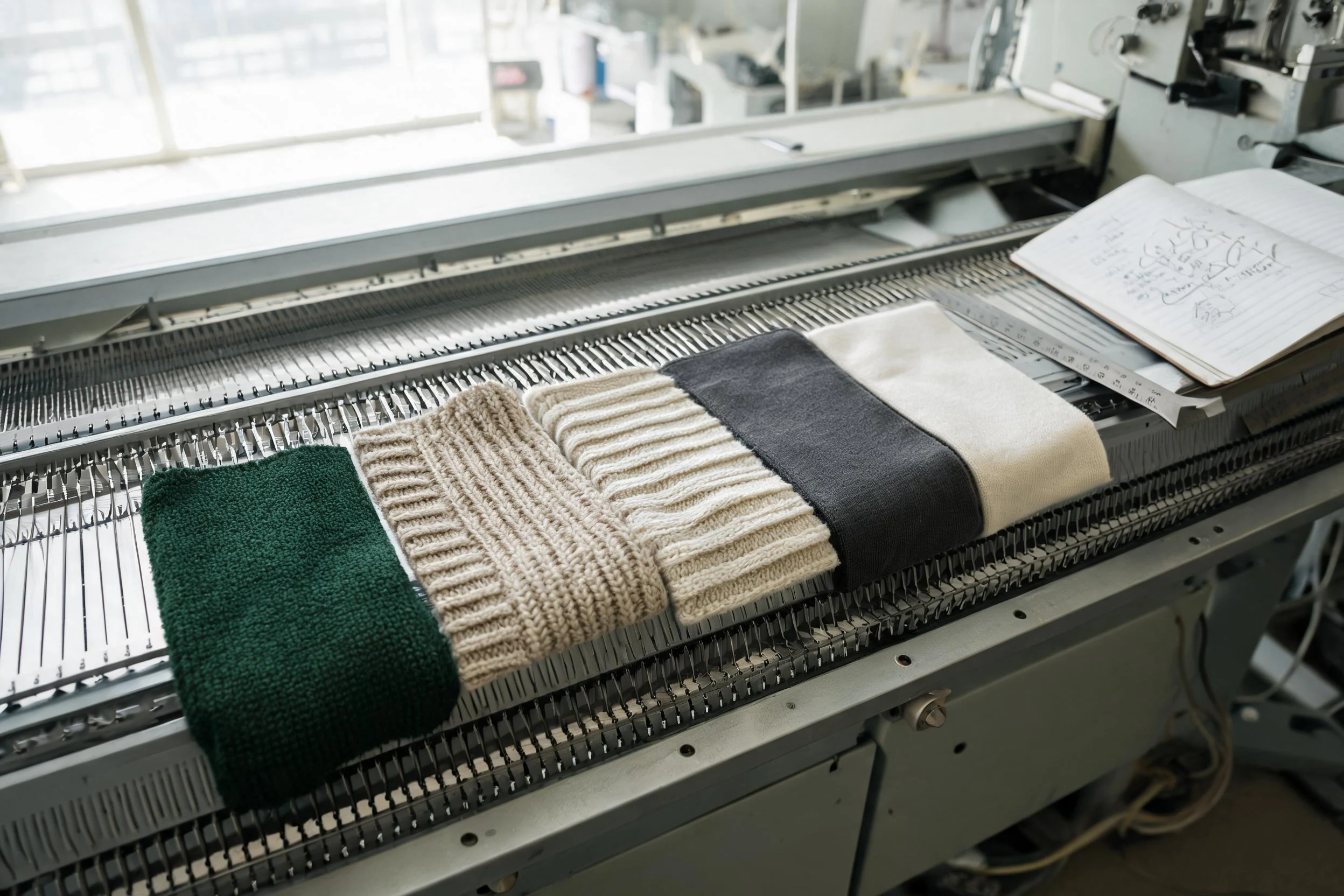
Five structures, one yarn family: milano, double-face, a 2×2 rib, a racked rib and a 16GG jersey, all on the machine bed this week.
For two seasons the interesting work in knitwear was in the stitch: transfers, openwork, coarser and coarser cables. What is on the sampling table now is quieter and, from a factory's point of view, harder. Buyers are sending references that are not decorated at all — a dress that holds a straight line, a cardigan with a clean flat edge, a knit that can be worn under a blazer without the shoulder collapsing. Nothing about those garments photographs as a trend, and all of them are decided by the structure.
That shift moves the cost conversation earlier. A jacquard is expensive in a way a buyer can see and therefore accept; a structure is expensive in ways that only show up in the yarn order and the machine minutes, and it is much easier to under-quote. So this is the review we would give a buyer standing at the table: five structures, what each one is genuinely good at, and which of them we would spend sampling money on.
Why structure replaced pattern
Three things pushed it, and all three are commercial rather than aesthetic. Pattern costs money per colourway — every additional colour is a new machine programme, a new yarn layout and a new set of samples. Structure costs money per piece, once, and then sells in one colour. When ranges are being planned in smaller drops with a longer shelf life, a buyer will take the piece that sells in navy and camel over the piece that only works in the print it was designed around.
The second pressure is tailoring. A firm knit can stand in for a woven jacket on the shop floor, and brands have noticed that a milano or double-face piece can be merchandised next to outerwear instead of next to sweaters. The third is touch: a plain jersey at 16GG, knitted well, feels more expensive than anything decorative at 7GG, and customers have learned to check with their hands before they check the price.
What has not changed is the penalty for getting it wrong. A decorated knit that shrinks is a fault; a structural knit that shrinks has lost the shape it was bought for. That is why the verdict on each of the five below leans on what the finishing step does to it, not on how it looks off the machine.
The five, one by one
1. Milano rib — the one that holds a line
Knitted on both needle beds with two yarns, one bed knitting plain and the other in rib, so the face is smooth and the back is ribbed. It is the most stable flat-knit structure we run, with very little lengthwise stretch and strong recovery, which is why it turns up in dresses, knit blazers and straight-cut skirts.
How we knit it: 12GG or 14GG, two yarn feeds, done on the whole panel so the edge is clean; a milano panel cannot be re-shaped after knitting the way a jersey panel can. Where the money goes: yarn and machine time both roughly double against a single jersey at the same gauge, because two yarns are running and the carriage is slower over the rib bed. Where it goes wrong: the two yarns have to be from the same dye lot and matched for count, or the face and the back take colour differently and the garment reads as two fabrics in daylight. Verdict: develop it — but order both yarns together, in one lot, and treat it as a single purchase.
2. Double-face — the one that behaves like a woven
Two separate layers knitted on two beds and joined at the edges, sometimes in two colours so the inside is a surprise. It gives a knit genuine body: a double-face coatigan hangs instead of draping, and a double-face panel takes a clean edge without a facing.
How we knit it: 7GG–12GG depending on how much weight the shape can carry; joined edges are linked by hand or on a dedicated machine. Where the money goes: yarn again — two layers use roughly twice the yarn of one — plus the linking, which is hand work and does not scale with a bigger order. Where it goes wrong: the two layers can shift against each other if the panel is cut or pressed carelessly, and a heavy double-face garment that is pressed flat loses the volume that justified the cost. Verdict: develop it for outer layers and tailored shapes; do not use it for anything that has to feel light.
3. Wide 2×2 rib — the one with the volume
Deep, generous, and at the moment the most requested surface in the folders after fine gauge. The rib pulls the fabric in width, so the garment reads narrower on the machine than it does on the body, and the vertical lines do most of the shaping for you.
How we knit it: 7GG–12GG in a 2×2 or 3×3 layout; hems and cuffs in a tighter 1×1 so the garment keeps its edge. Where the money goes: yarn per garment, because a rib panel has to be knitted wider to finish at the target measurement, and that is where a quotation quietly goes wrong. Where it goes wrong: width growth after washing. A 2×2 rib that is not given a wash test will come back wider and shorter than the spec sheet, and the press will make it worse if the steam is left on the rib too long. Verdict: develop it, and write the finished width after wash into the measurement sheet before the sample is approved.
4. Racked rib — the one that looks like pattern for free
Stitches transferred sideways at intervals so the rib walks across the panel in a diagonal or offset line. It is the cheapest way to make a plain knit look designed, which is exactly why it is being asked for now that jacquard budgets have gone.
How we knit it: 7GG–12GG, transfer every few courses; the density of transfers is the design decision and it is also the cost decision. Where the money goes: machine time — every transfer row runs slower, and a dense rack can add a meaningful share of the knitting minutes to a panel that would otherwise be plain. Where it goes wrong: a transfer point is a hole waiting to happen. Coarse, hairy or brittle yarns do not tolerate repeated transfer, and a needle that is slightly out of adjustment will leave a line of pin holes that only appears after washing. Verdict: develop it with a yarn we have already run through transfers, and knit a full panel rather than a swatch before you commit.
5. Fine jersey at 16GG — the one everyone thinks is free
Plain single jersey, no structure at all, and the piece that makes the other four wearable: the shell under the cardigan, the base under the coatigan. It is the cheapest thing in the range to quote and the most expensive to get right.
How we knit it: 16GG, fine yarn, narrow linking at shoulder and armhole so the seams do not read as ridges. Where the money goes: almost nothing in machine time — the cost sits in yarn evenness and in finishing discipline, which is invisible on a cost sheet. Where it goes wrong: at 16GG every slub, thick place and shade bar is visible. A yarn lot that passed at 12GG will not pass here, and a light colour will show it first. Verdict: develop it, and approve the yarn from the actual dye lot rather than from a shade card.
The five, side by side
| Structure | Gauge | Machine work | Cost driver | Main risk | Verdict |
|---|---|---|---|---|---|
| Milano rib | 12GG – 14GG | Both beds, two yarns, whole panel | Double yarn, slower carriage | Face and back taking colour differently | Develop; buy both yarns in one lot |
| Double-face | 7GG – 12GG | Two layers joined at the edge | Double yarn plus hand linking | Layers shifting; volume lost in pressing | For outer layers only |
| Wide 2×2 rib | 7GG – 12GG | Rib layout, tighter 1×1 at the edges | Yarn per garment (knitted wider) | Width growth and length loss after wash | Develop with a wash test |
| Racked rib | 7GG – 12GG | Regular transfers across the panel | Machine minutes per transfer row | Pin holes at transfer points | Develop only in a proven yarn |
| Fine jersey | 16GG | Single bed, plain, narrow linking | Yarn evenness, finishing discipline | Slubs and shade bars in the open | Develop; approve the actual lot |
Three questions that decide the structure before you sample
None of these is a design question, and each one moves the quotation more than a change of sketch would.
- Will it be worn next to a woven? A fine jersey under a woven shirt needs a different armhole and sleeve length than a fine jersey worn alone. Milano and double-face, by contrast, are firm enough to sit over a woven without the seam cutting in — which is the reason buyers reach for them when a knit has to work with tailoring.
- What is the weight ceiling? Double-face and milano both double the yarn, and on a long body that becomes a heavy garment. A coatigan in double-face at 12GG is a different product from the same silhouette at 7GG, and the customer notices the difference on a hanger before they notice the price.
- How many colours, and how many of them are light? Structure hides a lot, fine jersey hides nothing. A cream 16GG shell is the most expensive piece in the range to get right even though it is the cheapest to quote — the yarn and the handling do the work, not the machine. Plan cost per colour, at 300 pieces per style per colour.
If we were building the range
We would pair a milano dress with a 2×2 rib cardigan in the same yarn family, in two colours, and leave the double-face outer layer for the following season when there is budget for a proper wash-and-press trial. That pair covers both stories buyers are asking for — something that holds a line, something with volume — on one yarn approval and one colour card. The fine jersey shell is the third piece we would add: it is the cheapest way to make either of the other two look considered, provided the yarn comes from a lot we have actually seen.
Where structure meets the floor
A structure is decided in three places, and skipping one of them is how a sample and a bulk order stop matching:
- Design development — structure, gauge, yarn and target FOB are settled together. Choosing a 2×2 rib after the yarn has been ordered is the most common way a quotation is lost.
- Pattern and sampling — the flat is translated into stitch counts and courses, and the structure's shrinkage is measured on the first sample rather than assumed. Rib width and milano length are both set here, or they are set by accident.
- Production and finishing — linking, pressing and washing decide whether the structure survives. A milano edge is only as clean as the linking behind it, and a rib only keeps its width if the steam is controlled.
The sequence in this factory is a quotation within 48 hours of a usable tech pack, tech pack and yarn in 3–5 days, a first sample in 7–10 days per round, and bulk at 45–55 days after approval, at 300 pieces per style per colour with FOB Shenzhen or Guangzhou. Structures add time in proportion to machine minutes, not to the number of pieces — which is why a dense racked rib costs more per garment at 300 pieces than at 3,000, and why we would rather quote it from a full panel than from a swatch.
Three questions we get asked
Is milano more expensive than double-face?
Usually, yes — but not for the reason buyers expect. Both double the yarn; milano also runs slower over the rib bed, while double-face adds hand linking at the edges. On a short body the two land close together; on a long garment milano pulls ahead because the machine minutes keep accumulating across the whole panel. The honest answer is that they are within the same bracket, and the decision should be made on which surface the style needs, not on price alone.
Does the structure change the measurements after washing?
Every structure does, in different directions. Ribs grow in width and lose length; milano is the most stable of the five; double-face moves least but shows a press mark first. That is why we ask for a finished measurement sheet measured after wash and press, not off the machine — and why a rib that has never been washed cannot be approved on the strength of a first sample alone.
Can one yarn be used across two structures?
Often yes, and it is the cheapest way to make a small range look deliberate: the same yarn in milano for a dress and in a 2×2 rib for a cardigan gives two very different surfaces from one approval. The limit is count — a yarn fine enough for 16GG jersey will not carry a 7GG double-face, and a yarn heavy enough for a rib will look coarse at 14GG. We would settle the shared yarn at the development stage, with the coarsest structure in mind.