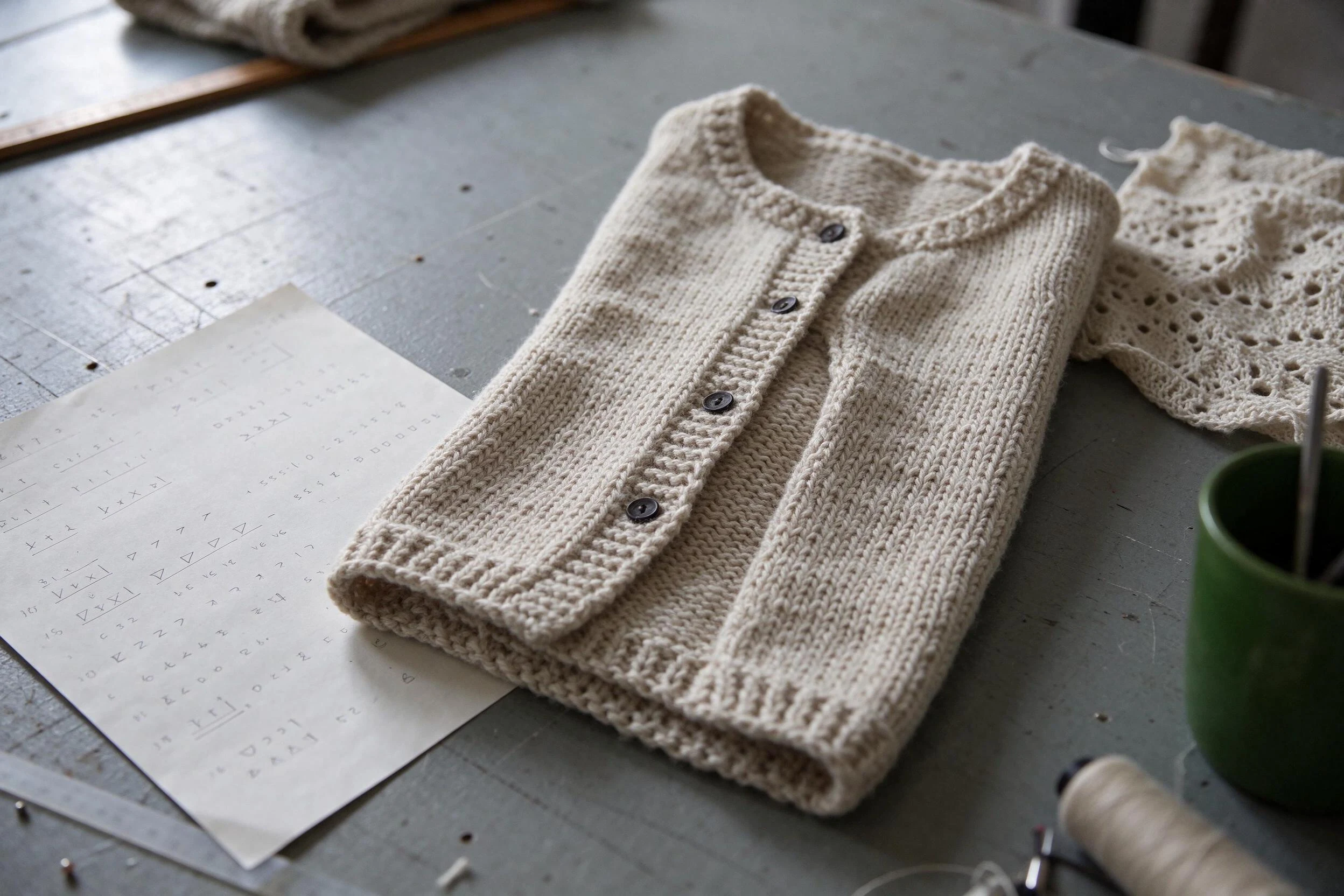
A 7GG cardigan with a deliberately irregular stitch and a hand-linked edge, next to the only document that makes it repeatable: a page of stitch symbols and a sealed swatch.
Two things arrived in the trade press this month, and they look like opposites. At the fairs, craftsmanship is back at the centre of the conversation — the January edition of Première Vision in Paris is built around making and hand, not around another print. On the machinery side the news goes the other way: a hydration vest knitted in one piece, every pocket built into the fabric itself, no cutting and no sewing.
Both are the same story told from two ends. The whole-garment vest removes operations; the craft story puts operations back in, but only the visible ones. For a design room the useful question is therefore not "hand-made or machine-made" but: which craft signals can a flat machine actually knit, which have to be done by a person, and what does the customer see at 50cm?
Below are the five signals that make a knitted garment read as hand-made. Each one is a program or a pair of hands, each has a cost that lands somewhere unexpected, and each has one place where bulk goes wrong. None of them is a styling decision alone — they are manufacturing decisions that happen to be visible.
One: irregularity, on purpose
A hand-knit is not irregular at random. It is irregular at a rhythm: two stitches a little longer here, a row that pulls slightly there, a selvedge that wanders by half a centimetre over 40cm. On a hand flat this comes free. On a modern machine it has to be written, and there are three levers: racking the needle bed one or two needles sideways mid-panel, dropping or adding a stitch outside the pattern repeat, and varying stitch length needle by needle across a few courses.
What it costs. Programming time first — a day to two days for a panel that would take an hour to write straight, because every variation has to be placed and then checked on a swatch. Then machine speed: the bed cannot run at full speed through a racking sequence, so a 7GG cardigan with irregularity is typically 18–25% above the plain version at the same yarn. The yarn has to tolerate it too: a springy lambswool takes racking beautifully, a slick viscose blend shows every transfer as a small hole.
How it fails in bulk. The irregularity resolves into a pattern. Put a variation every fourth course in six places and a buyer will find the repeat in ten seconds, at which point the garment reads as faulty rather than hand-made. Second failure: the left and right panels are written by the same program but knitted at different times, and a one-needle mirror error turns "hand-made" into "mismatched". Third: inspection. You cannot accept this look with a tape measure — a panel is allowed to be 1cm off and still be right, and a QC team trained on tolerance will reject good pieces unless the standard is written down.
What we need from you. One sealed, signed swatch that we both keep, a sentence describing the irregularity in words ("no more than two stitches of difference between neighbouring panels"), and agreement that this panel will never be measured to the millimetre. The sealed swatch is the whole quality standard; without it, every inspection becomes an argument.
Two: intarsia patchwork
A patchwork of colour blocks — the most literal way to make a knit look pieced by hand, because historically it was. On a machine each block needs its own yarn carrier, the blocks meet at a stitch boundary rather than a seam, and the two ends at every boundary have to be secured afterwards. That last part is where the hand comes in.
What it costs. Carriers, first: a flat machine carries a limited number of yarns, so three to six colours in one row is a sensible planning range and eight is a conversation. Labour second, and this is the number people miss: a panel with six blocks and five boundaries has ten ends to secure, and doing it invisibly takes a person a couple of minutes per join. On 600 pieces that is a line item, not a finishing detail.
How it fails in bulk. The boundary opens. After the first wash the two blocks relax differently, and a join that was tight on the sample shows a light line — on a dark ground it reads as a hole. Then the ends: an end that was not secured properly pulls back in wear and leaves a run. Then drift: a block that starts one stitch late makes the whole patchwork look hand-drawn in a bad way, and because it is knitted, it cannot be nudged straight by a seamstress.
What we need from you. The maximum colours per row, which boundaries are allowed to move by a stitch or two (all of them is easier than some), and whether the outer edge of an intarsia block is to be exposed or turned into a seam. An exposed intarsia edge is a design statement and a QC problem at the same time; decide before sampling, not after.
Three: pointelle and crochet-look openwork
The holes in a machine-knit are made by moving stitches, not by punching them: a transfer lace or pointelle pattern borrows the neighbouring stitch to close a hole and leaves a deliberate eyelet behind. A crochet look is a slightly different trick — chain and ladder structures at a coarse gauge, or an imitation-crochet transfer pattern, which at 3GG and 5GG can be convincing from a metre away.
What it costs. Time, and a lot of it. Every transfer slows the carriage, so a pointelle repeat typically adds 30–50% to machine time against the same gauge in plain. Add the yarn requirement: the yarn has to be smooth and reasonably strong, because a slub or a weak spot at a transfer point becomes a hole of the wrong size.
How it fails in bulk. The holes grow. Relaxation after washing opens an eyelet by 10–20%, which is nothing on a 4mm hole and a visible difference on a 1.5cm one, so the target has to be set on a washed swatch. Pressing closes them: an over-enthusiastic finisher can flatten a pointelle panel until it looks like a plain knit with a bad complexion. And a ladder structure runs — one dropped stitch and the ladder travels the whole panel, so both ends have to be anchored by a firmer structure or a seam.
What we need from you. Hole size given in stitches and in centimetres, the direction the ladder should run, and permission to knit one wash trial before the chart is fixed. Print a photo of a hole size on a tech pack and it will be misinterpreted; give a washed swatch and it will not.
Four: hand linking and hand edging
The most honest craft signal in knitwear is a person at a linking machine or with a crochet hook. Hand linking a neckline gives a seam with a slight, human tension; a crocheted or hand-bound edge gives a border that no program produces; a hand-embroidered chain stitch or a hand-sewn label does the same job at a smaller scale.
What it costs. Minutes, and the minutes are the price. A hand-linked collar is three to eight minutes a piece depending on gauge and width; a crocheted edge is fifteen to twenty-five; a hand-embroidered motif can be an hour. Multiply by pieces and you get the real number, and it does not fall with volume — it only falls a little with practice.
How it fails in bulk. Operator to operator tension. Two people linking the same collar produce edges half a centimetre apart, and the difference shows when the pieces sit side by side on a rail. Then the calendar: a workshop with four hands can finish 300–500 pieces a week, so a 2,000-piece order in three weeks is not a price problem, it is a capacity problem, and the usual result is that the last third is done by someone faster and less careful. Third, the edge that was supposed to look hand-made gets pressed flat and stops looking like anything.
What we need from you. How many hand operations per garment, the volume per colourway, and the date the goods must leave. If the answer is "crochet edge on 1,200 pieces by the end of the month", we will tell you that at the quotation stage rather than in week three.
Five: surface — fulling, brushing, garment dye
The fifth signal is not in the stitch at all but on the surface. Controlled fulling — a milling of wool that takes 3–6% out of the panel and closes the surface — gives the dense, slightly felted hand of an old knit. Brushing gives a halo. Garment dyeing gives depth that a stock-dyed yarn cannot, and a variation that stock dyeing never has.
What it costs. A trial, always. Fulling behaves differently on every yarn, so the shrinkage curve has to be measured on your yarn before anyone writes a measurement into a chart. Garment dye adds a dye house stage and a sampling round; brushing is cheap per piece and expensive in the control of it.
How it fails in bulk. Drift between loads: the same panel can come out 3% or 6% smaller depending on load size and time in the mill, which is a whole size between the first and last bulk. Shade variation between dye loads is normal in garment dye — if it is not agreed in advance as an acceptable range, you will reject your own bulk. Brush marks show a direction; a brushed panel sewn with the nap running the wrong way looks like two different fabrics under a shop light.
What we need from you. The surface you want as a physical reference or a photograph, the shrinkage you will accept in centimetres, and a shade tolerance written as a number of Pantone steps rather than "must match". All three are cheaper to agree now than to argue about at inspection.
The five, side by side
| Signal | Machine route | Cost sits in | Fails in bulk at | Tech pack must carry |
|---|---|---|---|---|
| Irregular stitch | Racking the bed, varying stitch length, miss stitches | Programming days plus slower carriage; 18–25% over plain | Visible repeat; left/right mirror error; QC rejecting on measurement | A sealed swatch and a written tolerance |
| Intarsia patchwork | One carrier per colour block, ends secured by hand | Carriers per row, plus minutes per join | Boundary opening after wash; ends pulling back; block drift of one stitch | Max colours per row; which boundaries may move |
| Pointelle / crochet look | Transfer lace, chain and ladder structures | 30–50% more machine time; a stronger, smoother yarn | Holes growing 10–20% after wash; pressing closing them; a ladder running | Hole size in stitches and cm; a washed swatch |
| Hand linking and edging | Linking machine and crochet hook, by hand | 3–8 minutes per collar, 15–25 per crochet edge | Operator-to-operator tension; the last third of the order | Hand operations per piece; volume; ship date |
| Surface finishing | Milling, brushing, garment dye | A trial panel on your yarn, every time | 3–6% shrinkage drift between loads; shade range; brush direction | A physical surface reference and a shrinkage limit |
Three things the machine will not do
Worth saying plainly, because all three come up in the first meeting.
It will not be irregular in a way that stays surprising. A program repeats. We can make the repeat long — twelve courses instead of four — and vary two parameters instead of one, and that is enough for a garment seen on a person at a metre. It is not enough for a customer who turns the cuff inside out and studies it. If the brief is "it must look hand-knitted up close", the answer is hand-knitting, and there is a workshop for that in the region, at a different price and a different lead time.
Whole-garment is not a licence for any shape. Knitting a piece in one go — pockets included, as in the hydration vest in this month's machinery news — removes linking and seams and gives a very clean inside. It does not remove the needle bed: the width of the piece is still set by the machine, the shaping is still a schedule, and the whole-garment machines are a separate family from the warp-knit machines where the width is fixed by the beam before the first course. A shape that needs both a narrow waist and a stiff, dense surface is two garments, not one clever one.
Hand work does not scale linearly. Twenty pieces can be beautiful. Six hundred need a standard, a sealed sample and a named person responsible. Two thousand need a different design, because the hand element has stopped being a craft signal and become a bottleneck with a quality risk attached.
Three lines we can develop this season, and the IP line
These three are the craft directions we are being asked for most often at the moment, and all three are manufacturable here. What follows is what we can develop from a reference, and what we will not do with one.
- An irregular-stitch cardigan at 7GG. Racked bed, stitch length varied on a twelve-course repeat, hand-linked button band, wooden buttons. The stitch is the design; everything else stays quiet. Cost sits 18–25% above a plain 7GG cardigan, and the sealed swatch is the contract.
- A pieced jacket at 3GG or 5GG. Four to six intarsia blocks with exposed boundaries, a crocheted edge and no lining. The labour is at the joins, not in the knitting, so the price is driven by how many boundaries you can accept — five is comfortable, ten is a different conversation.
- A pointelle top at 12GG. A six-course transfer repeat, a crochet-look neckline, and a hole size that survives washing. Cheap to knit, expensive to get wrong: the wash trial is not optional and the chart should be written after it, not before.
On all three, the same five lines apply:
- A technique is not owned; a published chart is. Cabling, intarsia, crochet edging — nobody owns the method. A specific stitch chart printed in a book or a magazine is the author's work, and we do not knit from one, nor from a scan of one, nor "with two stitches changed".
- Motif and artwork are the protected part. A jacquard repeat, a placement design, an embroidered figure: these belong to whoever drew them. Redrawing 20% differently is not a defence.
- Garment shapes can be registered. In several markets a recognisable shape can hold a design right for a period. A near-copy of a commercial piece deserves an afternoon's check before it goes to sample.
- No reverse-engineering a purchased garment. We will measure a reference for proportion and read its structure with a lens. We will not unpick a branded piece to recover its program, and we do not accept a competitor's pattern file.
- Say what the garment is. If it is machine-knitted with a hand-linked collar, call it that. "Hand-knitted" on a machine-knitted piece is not an IP question, it is a consumer-law question, and in most markets it is the more expensive of the two.
What to put in the craft section of a tech pack
Five entries, and none of them is a mood board:
- The signal, named. Which of the five you are buying — so nobody optimises the wrong one away to save 4%.
- The reference, sealed. One swatch per signal, signed and dated by both sides, kept by both sides.
- The tolerance in words. How much difference is still this garment, and how much is a fault. Written for an inspector, not for a designer.
- The hand operations and the volume. Per piece, per colourway, against a ship date we can actually staff for.
- The finish and the wash. Surface reference, shrinkage limit, and whether the piece is washed before or after making — because that decides which measurement is the real one.
Send those five with a sketch and we will come back with a craft cost breakdown — where the money is, what can be removed without losing the look, and which of the five signals your yarn will not support.
Craft is a cost line, not a mood
Every craft signal on this page is either machine time or a pair of hands. Machine time you can buy in 18–25% increments; hands you buy in minutes, and there are only so many minutes in a week. Decide which one you are buying before the first sample, and the quotation will not change between sample and bulk.
Three questions we get asked
Can you make it look genuinely hand-knitted?
At a metre, on a person, yes — with a sealed swatch and a long repeat. In the hand, no, and we would rather say so now. What we can do is put the hand where it shows: the collar, the button band, the edge, the label. Those are the parts a customer actually touches.
How much does a craft look add to the price?
On the machine, 18–25% for irregularity and 30–50% machine time for a dense pointelle. In labour, three to eight minutes for a hand-linked collar and fifteen to twenty-five for a crocheted edge — per piece, in every size. An intarsia jacket with five boundaries typically adds 15–30% to the making charge before the hand work.
We bought a sample we love — can you copy it?
We can measure it, read the structure and tell you how it was made, then build a development of our own from your brief. We will not unpick a branded garment to recover its program, and if the stitch chart comes out of a book, we will not knit it. Those two lines cover most of the risk, and neither of them costs you a season.