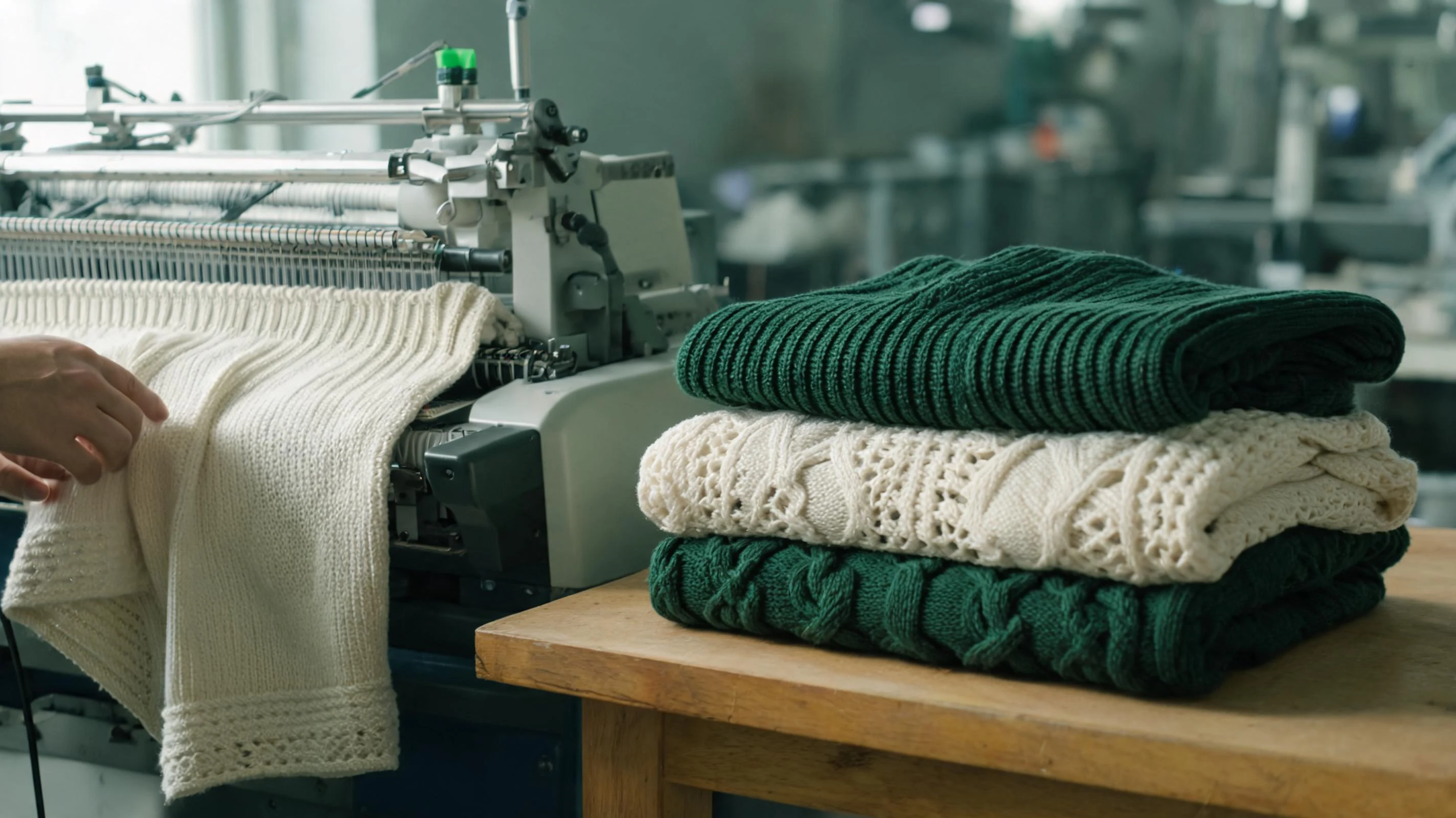
Sample room, Changping: the same three questions are asked of every technique that comes in.
A buyer's trend document usually arrives as images. Our job is to convert those images back into machine settings, yarn counts and finishing minutes — and then to say, plainly, what the difference is between the version in the photo and the version at your target price. When buyers ask "is this a real trend or a runway thing?", the honest answer comes from three questions we ask of every technique below: can it run at 300 pcs per colour, does it survive washing and pressing, and which minutes does it add?
1. Fine gauge, worn close to the body
The most persistent direction in womenswear knitwear is the fine-gauge piece that behaves like jersey: a 16GG or finer plain knit, or a narrow 1×1 rib, cut close and styled under tailoring. It photographs beautifully and it layers, which is why it keeps returning.
What it asks of a factory is less obvious. Finer gauge means more needles and more minutes per panel, but it also exposes the yarn: at 16GG a slub or a shade bar that a 7GG knit would swallow becomes visible on the surface. Fit also becomes a design decision rather than a grading exercise — two centimetres of negative ease can turn a dress into shapewear, and the linking at the neckline has nowhere to hide.
Our verdict: worth doing, but not with a cheap yarn. A 12GG knit in a good, even yarn usually reads finer and more expensive than a 16GG knit in a coarse one. If the budget is tight, move the money from gauge to yarn — the hand tells the truth before the label does. Gauge, explained.
2. Openwork: pointelle, mesh and crochet-look
Holes are back in the polite version: pointelle ladders, mesh panels, crochet-look stitches built on the machine rather than by hand. It is a strong direction for dresses and layering pieces, and it is one of the few techniques where a 7GG machine earns its place in a summer range.
Technically, every hole is a transfer — the needle gives its stitch to a neighbour and takes it back a row later — so an openwork panel takes longer to knit than a plain panel of the same size, and the machine loses speed. It also produces more seconds: a dropped stitch in an open structure is a hole where a hole should not be, and mending is hand work.
Our verdict: good value for summer and resort ranges. Two conditions: ask for a wash test on the actual yarn, because open structures move and can close up after finishing; and specify whether the holes must stay open after pressing, since a heavy press will flatten them.
3. Three-dimensional texture: cables, ottoman rib, mixed ribs
Texture is the cheapest way to make a knit look expensive, which is exactly why it keeps selling. Cables, ottoman ribs and panels where a 3×3 rib meets a plain knit give a garment visible structure without changing the silhouette.
The cost sits in yarn and time: a textured panel uses noticeably more yarn than a plain knit at the same gauge, the machine runs slower, and the pressing step has to be disciplined — press too hard and the relief disappears, press too little and the panel edges wave. This is also the technique most often ruined at the sample stage by a yarn that is too soft to hold the stitch.
Our verdict: the best return on cost in this list, especially for chunky 3GG–7GG outer layers. Send a swatch photograph with the light raking across it, not a flat lay; relief is what you are buying.
4. Whole-garment and fully-fashioned construction
Seamless and whole-garment knitting continues to appear in trend decks as a sustainability story: fewer cut panels, less waste, less labour. The claim is fair, but it is not universal. Whole-garment machines knit a garment in one piece with the size engineered into the loop count, which works well for simple shapes and skips the cutting room entirely.
The trade-offs: a narrower set of available structures, a longer programming stage before the first sample, and a cost curve that does not necessarily bend downward at 300 pieces. Fully-fashioned is a middle path — panels are knitted to shape and linked, so there is little cutting waste but the garment is still assembled.
Our verdict: strong for clean, simple silhouettes; poor for styles that depend on drape or heavy texture. When a supplier says "seamless", ask which of the three they mean — whole-garment, fully-fashioned, or cut-and-sew with a seam that has been flattened.
5. Brushed, milled and washed finishes
A brushed surface sells hand-feel in about three seconds, and after several seasons of soft, cosy knitwear the finish has become a selling point in its own right. Milling and washing do something similar: they shrink the fabric slightly, blur the stitch and soften the surface.
These are the techniques with the most hidden risk, because the finishing step changes the garment after knitting. Shrinkage has to be measured on the actual yarn and the actual finishing lot, pilling has to be tested rather than assumed, and a deep shade can shift in tone after a wash. Budget several days of finishing and a shrinkage figure in the measurement sheet, not just a hand-feel description.
Our verdict: recommended, with a wash test before bulk and a clear acceptance standard for pilling. A brushed knit that pills in the shop is worse than a plain knit that never promised softness.
6. Jacquard and intarsia
Patterned knits return every time a house wants a graphic statement. Jacquard carries the pattern across the full width; intarsia carries separate yarns for separate colour blocks, which means hand work at the machine.
The cost driver is colour count far more than piece count: each additional colour is another yarn, another feed and, in production, another chance for a shade mismatch between dye lots. Intarsia also adds handling time and a higher risk of tension marks at the colour boundary.
Our verdict: worth it when the pattern is the point of the garment. Keep the palette tight, use jacquard for all-over repeats and intarsia for isolated motifs, and decide the colour count before you fall in love with the artwork.
The six, side by side
| Technique | What buyers respond to | Main cost driver | Our verdict |
|---|---|---|---|
| Fine gauge (16GG+) | Quiet, layerable, close to the body | Machine minutes and yarn evenness | Worth it — spend on yarn first |
| Openwork | Lightness, summer texture, layering | Transfers, slower knitting, mending | Worth it for warm seasons |
| 3D texture | Visible value, tactile surface | Yarn consumption, machine speed, pressing | Best return on cost |
| Whole-garment | Clean inside, less waste | Programming, limited structures | Simple shapes only |
| Brushed / milled | Softness, cosiness | Finishing days, shrinkage risk | Yes, with a wash test |
| Jacquard / intarsia | Graphic impact | Colour count, hand work | Yes, with a tight palette |
What we would actually put in a range
If a buyer asked us to build a commercial range from this list, we would not use six techniques in six styles. We would pick two: one texture story and one fine-gauge base, and let the rest of the range be plain knits in the same yarn family. A range holds together when the yarns are related; it fragments when every style is a separate technical adventure, and each adventure costs a sampling round.
That is also the commercial argument. Three techniques in six styles means six sample yarns, six sets of finishing trials and six chances of a bulk surprise. Two techniques in six styles means one yarn development, one finishing standard and a price list a buyer can plan a season around.
A technique is only a trend once it can be repeated. Repetition is a manufacturing question, not a design one.
Where design and manufacturing meet
None of the six decisions above is settled in a lookbook. Each one is settled in three places, and skipping any of them is how a sample and a bulk order stop matching:
- Design development — the swatch, the yarn and the gauge are chosen together, and the target FOB is written down before the first sample.
- Pattern and sampling — gauge becomes measurements; openwork, texture and finishing are tested on the actual yarn, not on a reference.
- Production and finishing — the pressing discipline, the wash and the acceptance standard for pilling are held on every lot, not just the first.
That is the unglamorous part of trend work, and it is where most of the money is either protected or lost. A buyer who arrives with a photo and a target price gets a useful answer only if the factory can translate the photo into those three stages — which is why we would rather talk about a technique's minutes than about whether it is "in".
What to put in the tech pack for a trend-led style
Reference image with the part you actually like marked (the stitch? the fit? the finish?); yarn composition and count, or a swatch; gauge; whether holes and texture must stay open after pressing; finishing and wash expectations; colour count; quantity per colour; and the date goods are needed. With those, a quote is a calculation. Without them, it is a guess that gets corrected at your expense.
Three questions we get asked
Is fine gauge more expensive than chunky?
Per panel, usually yes — more stitches means more minutes — but chunky knitwear uses more yarn. Which one lands higher depends on the yarn and the structure, so we quote both rather than applying a gauge-based price list.
Can you knit openwork without it snagging?
We can reduce the risk: tighter tension at the transfer, a plied yarn rather than a single, and a finishing route that does not flatten the holes. We cannot remove it entirely — an open structure is by definition a place where a ring or a bag strap can catch.
Do we need a separate sample for each colour?
Not always. A colour can be approved on a swatch when the yarn is available in that shade, but a new colour in a brushed or milled finish should be re-sampled, because the finishing step can shift the tone.