
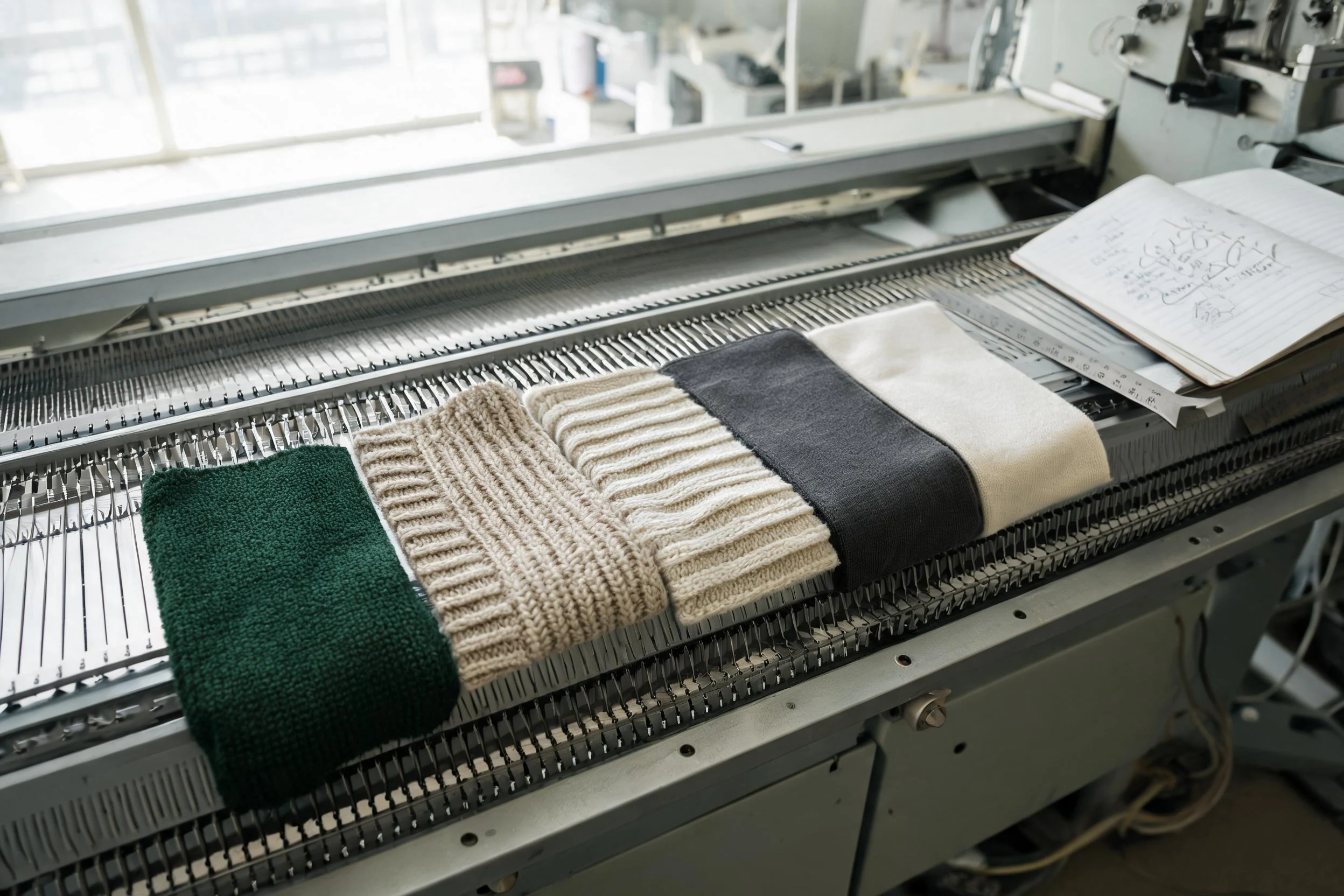
Five panels, five structures. A pattern sits on top of that decision: the same motif reads differently on a Milano, a wide rib and a 16GG jersey — and on two of the three it cannot be knitted in at all.
Patterned knitwear is back on the rail — diamonds, collegiate lettering, placed graphics, two-colour ribs — and with it the question we get every week: can you make this? The honest answer is that there are five ways to put a pattern on a knitted garment, they are not interchangeable, and the cheapest one is often invisible on a photograph.
This note takes the five and asks the same four questions of each: how it is made, where the cost sits, where it fails in bulk, and what we need from you before we can price it. Then the part that decides whether a motif ever reaches bulk: who owns it.
What the trade is talking about this month
The design pages of the knitting trade press this month are about structure, not print: studio research into knitted structure, a project on acoustic knitting, one-piece engineered garments with every pocket knitted into the fabric, and machine makers presenting their design platforms at the winter trade fairs. Read together, the message is the same from every direction — on a knit, a pattern is data before it is a surface. Somebody has to decide which needles carry which yarn, in which row, and whether the back of the cloth is allowed to show.
That is the opposite of how a graphic is normally drawn. A print file is a picture; a knit file is a set of instructions, and the instructions cost money per row. So the question is never "which pattern is cheapest" in general. It is: which of the five routes still gives you this motif, on this gauge, at this quantity, with a back you can live with.
One: jacquard, the motif knitted into the panel
The pattern is worked on the machine: needles select coloured yarns row by row, and the design lives inside the panel rather than on it. On a single-bed jacquard the colours not in use float behind the face; on a double-bed jacquard those floats are tucked between the two beds and the back is much cleaner — but the machine runs slower and not every mill has the bed for it.
Where the cost sits: yarn first. Every row carries every colour across the whole width, so a four-colour jacquard can consume two and a half to three times the yarn of a plain panel of the same size. Then programming, then speed — a jacquard runs at a fraction of the rate of a plain knit, and that time is in the price.
Where it fails in bulk: floats that are too long snag on rings and bag straps, and the first place it shows is the inside of the cuff; a motif that runs into the armhole or the neck gets cut off by the shaping, which nobody notices until the sample is on a body; and on a coarse gauge a wide motif pulls the panel narrower than the flat drawing promised.
What we need from you: the artwork at scale with the repeat marked, the colour count (five is comfortable, seven is a negotiation), and permission to interrupt the motif at the side seams and at the armhole — or a keep-out zone at each shaped edge, usually 2cm.
Two: intarsia, colour blocks knitted side by side
Each colour area gets its own yarn carrier, so blocks sit next to each other with no floats behind them at all. The back is as clean as the front, the cloth keeps its full stretch, and this is the only route that carries a large graphic — a diagonal stripe, a big letterform, a wide colour field — without a wall of carried yarn behind it.
Where the cost sits: carriers limit how many colours can appear in one row, typically six to eight depending on the machine, so a design with more colours is split into panels or simplified. It is slower than jacquard. And the joins are hand work: every colour change leaves a yarn end that has to be tucked and finished by hand at the end of the panel, which is a per-panel labour cost that scales with the number of joins, not with the size of the garment.
Where it fails in bulk: small holes at the joins when the carrier tension is set wrong, which read as faults at inspection and cannot be pressed away; joins that sit exactly on a shaped edge and open when the seam is linked; and a wide intarsia block on a 3GG brushed yarn that pulls the panel out of width after washing.
What we need from you: a colour-block diagram with the boundaries drawn, not a reference photo; the colour count per row; which colour is dominant, because that decides how the yarn is wound and how the carrier is set; and confirmation that no join runs closer than 3cm to a side seam.
Three: floats, the cheap route for a small repeat
Stranded knitting — Fair Isle and its descendants — carries the unused colour behind the work and brings it forward where the pattern needs it. On a small repeat it is the cheapest pattern a knit can have after stripes, because nothing extra is cut, sewn or printed: the machine simply knits a different needle selection.
Where the cost sits: yarn, again, though less than jacquard because the repeat is narrow; and a small amount of programming. There is no extra operation, no screen, no frame. That is why an all-over two-colour pattern on a fine-gauge jumper is often cheaper than a single printed logo.
Where it fails in bulk: a float running over more than five needles will catch on anything; the inside becomes a tangle that shows at the hem when the garment is worn open; on 16GG the floats print through to the face after two or three washes, so a pattern that was crisp at sampling goes cloudy; and floats take stretch out of the cloth, which stiffens cuffs and hems that were meant to be soft.
What we need from you: the repeat size in centimetres, not in screens; whether the inside of the garment is ever seen (if it is, the back gets lined or bagged, and that is a separate cost); and whether the pattern crosses a cuff or a hem, where the float density changes with the rib.
Four: embroidery and appliqué, stitches on top of the cloth
Embroidery puts thread through a knitted surface, which means the needle has to be given something to hold: a water-soluble film on top, a tear-away or cut-away backing beneath, and a stitch density chosen for a cloth that stretches. Appliqué sews a separate piece on instead — and inherits the oldest rule in this factory, the same one that governs a patch pocket: same yarn lot, same gauge, relaxed together, or the patch and the body will shrink apart in the first wash.
Where the cost sits: stitch count. A 10,000-stitch chest logo and a 25,000-stitch one are different prices and different risks; each placement needs its own frame, so two logos on one garment is two setups; and backing removal is hand time on a fine gauge, where a cut-away backing would show.
Where it fails in bulk: puckering around a dense logo, because the stabiliser was chosen for a woven and the knit relaxed after it was removed; wale splitting where the needle lands on the same column twice; a hard backing printing through on a light 16GG merino after washing; and a knitted appliqué that shrinks and lifts at the corners, which is a yarn-lot problem far more often than a sewing problem.
What we need from you: a vector file with the finished size, a stitch-count target, the placement measured from a fixed point, and whether the patch is knitted or woven. If it is knitted, we will ask for it to be made in the same lot as the body — that one sentence prevents most of the failures in this paragraph.
Five: print on knit, ink on a surface that moves
Screen print, pigment, plastisol, discharge or digital. All of them put colour on top of a cloth that stretches in two directions and is built out of columns, and that is where the problems start. On a 16GG jersey a print holds well if the ink is matched to the stretch. Over a 2×2 rib it breaks at every rib line, and no amount of registration fixes it — the pattern has to be designed around the rib or the rib has to be flattened first.
Where the cost sits: screens, one per colour, plus a strike-off and a curing step. Digital has no screens and no minimum, which makes it the right answer for a photographic placement on a small first order and the wrong one at 3,000 pieces. Set-up is cheap compared with jacquard; the per-unit cost overtakes it above a few hundred pieces.
Where it fails in bulk: ink that cracks after twenty washes because it was specified for a woven; a large solid print on soft merino that turns the front of the garment into a panel with no drape; discharge printing specified on a blend with polyester, where it simply will not discharge; and placement that shifts, because the panel relaxed 4% after the wash test and 4% over a 40cm body length is a centimetre and a half.
What we need from you: artwork at final print size, the colour count, the print area measured on the flat, whether the print crosses a seam or a rib, and whether the garment is garment-dyed — in that order, because the last answer decides whether discharge is available at all.
The five, side by side
| Route | How it is made | Cost driver | Where it fails in bulk |
|---|---|---|---|
| Jacquard | Colour selection on the machine; floats behind the face or tucked between beds | Yarn — up to three times a plain panel — plus programming and machine speed | Long floats snagging; motif cut by armhole shaping; panel pulling narrow |
| Intarsia | One carrier per colour area, blocks knitted side by side | Carrier limit per row, slower running, hand-tucking every join | Holes at the joins; joins opening at a linked seam; width lost after wash |
| Floats | Unused colour carried behind, small repeat only | Yarn and a little programming; no extra operation | Snagging over five needles; floats printing through on fine gauge; stiffness in ribs |
| Embroidery / appliqué | Stitched through a stabilised knitted ground, or a patch sewn on | Stitch count, one frame per placement, backing removal | Puckering; wale splitting; backing showing; appliqué shrinking |
| Ink applied to the finished panel, then cured | Screens per colour, strike-off, curing; digital is per unit | Cracking after wash; broken registration over rib; placement shifting with relaxation |
What a pattern does to the pattern room
A motif does not grade. A body can be graded by adding stitches at defined points; a pattern cannot, because at some size the repeat stops dividing by the panel width. So there is a decision to make before the size run, and only two honest answers: let the motif scale with the size, which keeps the proportion and changes the program for every size, or hold the motif at one size and re-place it, which keeps the artwork and leaves more ground at the edges on the large sizes.
The second thing that catches people is shaping. Armholes, necklines and the shoulder slope all remove needles, and a motif that runs to the edge will be cut by the decrease. Our rule is a keep-out zone at every shaped edge — usually 2cm, more on a coarse gauge — and it is written on the pattern file rather than agreed on the phone. On print the same problem appears as drift: a panel that relaxes 4% in the wash moves a placement by a centimetre and a half over a 40cm length, which is the difference between a logo sitting at the chest and sitting under the bust.
What to send with a pattern enquiry
- Artwork at scale, with the repeat marked. A JPEG of a motif is a mood; a vector with the repeat stated in centimetres is a specification.
- Colour count and references. Five colours on a jacquard is comfortable, seven is a negotiation, and intarsia is limited by carriers, not by ambition.
- Gauge of the body. It decides which of the five routes exists at all: a fine print holds on 16GG jersey and breaks on 3GG brushed wool.
- Placement from fixed points. From the hem, the centre front or the shoulder — not from a photograph with a red circle drawn on it.
- Whether the inside is seen. This one line decides between jacquard, floats and intarsia faster than any cost sheet.
- Where the motif came from. Yours, a licensed artwork, or a reference garment. The third answer changes the whole conversation, and it is better had now.
Where the IP line sits on a pattern
A motif is the most claimed surface in knitwear. More claims are made about pattern than about silhouette, construction or trim, because a pattern is the easiest thing for a customer to recognise and the easiest thing for a lawyer to describe.
What is open:
- The technique. Jacquard, intarsia, stranded knitting, embroidery and print belong to nobody. Using the same method as a reference garment is not copying.
- A generic motif class. Diamonds, stripes, houndstooth, checks in themselves, a colour combination as such. A diamond is not owned; a specific registered rendering of one can be.
- Your own re-development. If we redraw a reference motif to a defined set of changes — repeat, scale, colour count, edge treatment — the result is a new artwork with a record behind it.
What is not open:
- A registered design on a motif or a placement. Some patterns and some all-over placements are registered. We will not reproduce one, and we would rather say so at quotation than at the second sample.
- A house check or monogram that functions as a trademark. This is where a "generic" check stops being generic: if the trade recognises it as one brand, it is not available, whatever the pattern office says.
- Copyrighted artwork, characters and photographs. A print of an illustration is a reproduction of an artwork, and the licence has to come with it — not with the factory.
- Trade dress. Motif plus colourway plus placement plus trim, together, can read as one brand even when every element is individually free.
Our practice is the same as on construction: a documented re-development. What changed, why, and which reference it started from goes into the order file with the approved sample and the strike-off. Two seasons later, if a claim arrives, that file is the whole answer — and it also lets you move the style to a second supplier without losing the reasoning.
Three questions before the motif is drawn
Will the back of this garment ever be seen? Is the motif the design, or a decoration on a design that already works without it? And is this motif ours to use in the markets we are selling into? The first decides jacquard, floats or intarsia; the second decides how much money the pattern deserves; the third decides whether it ships at all. In our experience the expensive pattern is never the one that cost the most per piece — it is the one that was chosen before those three questions were asked.
How a pattern runs through the floor
A pattern is chosen in design, programmed in the pattern room and proved on the finishing line:
- Design development — the route is fixed against gauge, yarn and quantity before the quotation, not after the first sample.
- Pattern and sampling — the repeat, the keep-out zone at shaped edges and the program are set here, and the first sample is knitted with the real colour count.
- Production and finishing — wash test, strike-off approval and inspection decide whether the pattern is still the one that was approved when the carton closes.
Our standard sequence: quotation within 48 hours of a usable pack, tech pack and yarn in 3–5 days, first sample in 7–10 days per round, bulk at 45–55 days after approval, at 300 pieces per style per colour, FOB Shenzhen or Guangzhou, full inspection to AQL 2.5.
Three questions we get asked
Can you reproduce this print exactly?
Not from another brand's garment, and not from a photo of one. We can redevelop it: same family of motif, redrawn to a repeat and a colour count that suits your gauge and your quantity, with the changes documented. If the artwork is yours and you can send the file, that is a different conversation and a much faster one.
How many colours can a jacquard take?
Mechanically more than you want. Five colours is comfortable on a 12GG body; beyond six, yarn consumption and machine time climb faster than the design improves, and the back of the cloth gets heavy enough to change the drape. If a design needs ten colours, the honest suggestion is usually intarsia blocks or print, not a ten-colour jacquard.
Does a pattern change the MOQ?
The minimum stays at 300 pieces per style per colour. What changes is the set-up: a jacquard or intarsia design needs a program per size, an embroidery design needs a frame per placement, and a print needs a screen per colour plus a strike-off. On a 300-piece first order those are real numbers per unit, which is why we quote the pattern as its own line rather than folding it into the garment price.