
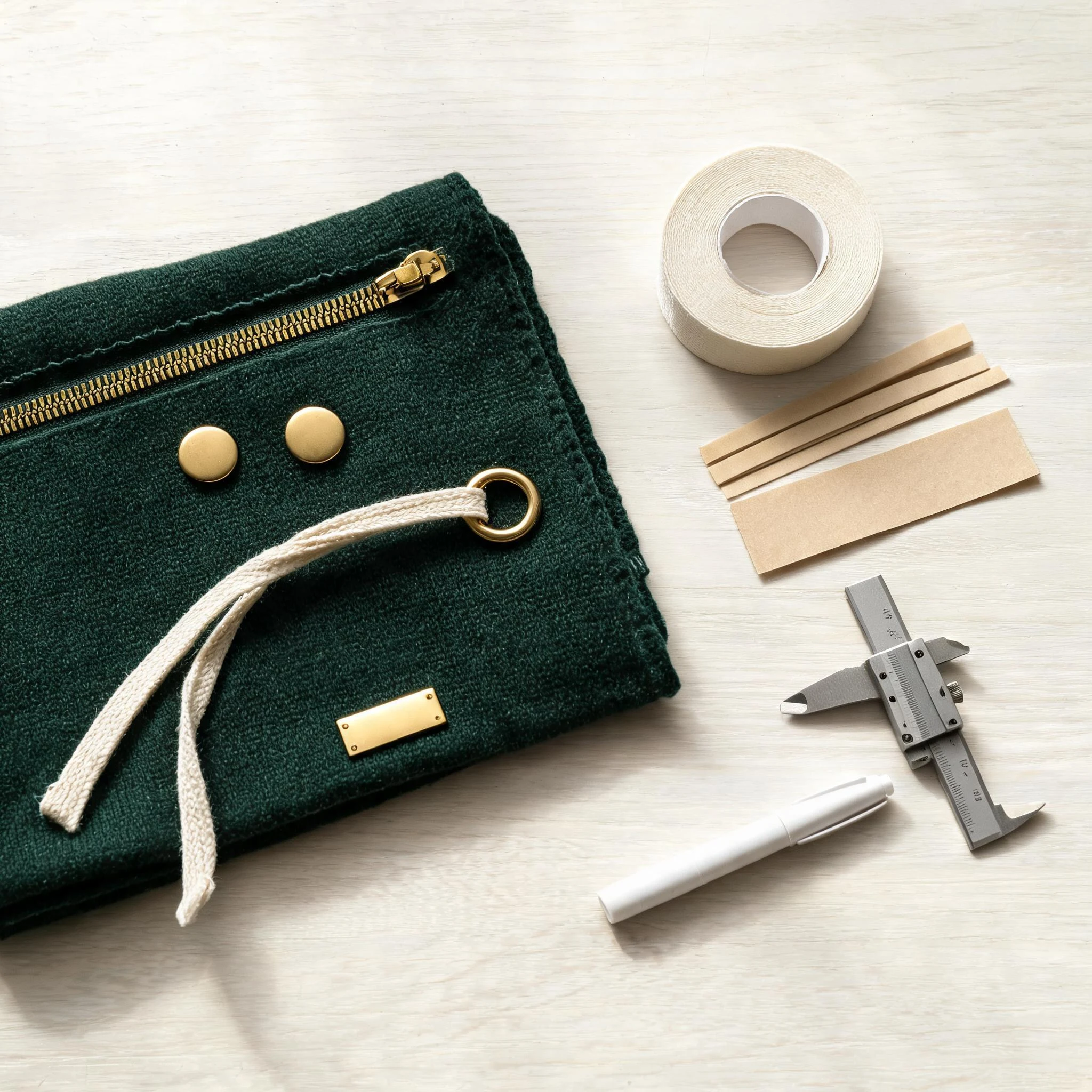
Four of the five, set on swatches: a zip on stabilised tape, two press studs, an eyelet with a cotton cord, and a metal plate on a doubled panel.
Ask a buyer what decides whether a knit sells and they will name the yarn, the colour or the shape. Ask the finishing line and the answer is usually something smaller: a zip that waves, a stud that pulls through, a cord that has gone thin at the eyelet after ten washes. None of those are design mistakes. They are the predictable result of setting a rigid object into a fabric whose whole job is to stretch.
This note takes the five pieces of hardware that turn up on knitted garments most often, and for each one asks the same four questions we ask in the sample room: how is it set, where does the cost sit, where does it fail in bulk, and what do we need from you before we can cost it honestly.
What the trade was talking about at the Shanghai show
ITMA Asia + CITME 2026 closed at the National Exhibition and Convention Center in Shanghai on 24 November, and the flat-knitting side of the hall was, as usual, about speed and gauge. Shima Seiki used the show for its latest developments in advanced flat knitting; the machine makers are selling a combination now — machine, application software and the design service that goes with it — rather than a needle bed on its own.
None of that solves our problem. A faster machine makes more panels per shift; it does not make a zip sit flat on a knitted edge. If anything the trend line is the other way round: the season's knitwear is asking for more hardware — half-zips, utility pockets, drawcords, metal plates — at the same time as it asks for softer, more fluid yarns. Softer yarn plus more metal is exactly the combination that fails in bulk.
One: the zip, a rigid line on a moving edge
A zip is the most demanding piece of hardware you can put on a knit, because it is the one place where the garment is asked to stop stretching. A 5mm-thick brushed knit and a nylon coil zip move differently under the needle, and if nothing is done about it the knit wins: it relaxes, the zip does not, and the front of the cardigan waves.
Three routes, in order of reliability:
- A stabilised and taped edge. A fusible strip plus a narrow woven tape is set along the front or the neck opening before the zip goes in, and the zip is sewn through all of it. This is what a half-zip pullover needs at any gauge, and what a full-front cardigan needs above 7GG. Cost: the tape, one more operation, and a pressing step to set the fusible without shine.
- A denser or finer knitted edge. The front panel is knitted at a tighter stitch count so the edge itself has less stretch. Cleaner, no tape, and it holds up to washing better — but it means a second machine setting and a pattern that has to be built for it from the start.
- Zip sewn straight into an unstabilised knit. Fastest and cheapest, and the one that produces the complaint. It can pass on a dense 16GG jersey; it will not pass on a 3GG brushed yarn.
Where the cost sits: the tape and the setting step, plus the zip itself — a metal zip on a knit is mostly a weight decision, because the pull hangs and drags on the edge every time the garment is worn. Where it fails in bulk: the wave, first noticed after a week on a hanger, and the hem, where the two fronts no longer meet by a centimetre because one panel was cut from a slightly different place in the piece.
What we need from you: zip type (nylon coil, moulded or metal), tape width, slider and pull finish, and whether the zip is a design element or a closure. On a half-zip, also tell us whether the collar stands up over the zip or folds flat — that decides the collar depth and the zip length, and getting it wrong costs a sample round.
Two: press studs, where prong length beats finish
A snap is a small object that relies on the fabric being compressed between two parts. On a woven shirt the fabric is 0.15mm thick and the prong is sized for it. On a 3GG jacket the fabric can be five millimetres thick, and the same stud will either not close or pull through the knit after a month.
So the first question is not brass or nickel — it is prong length, and whether the area behind the stud is doubled. On a knitted placket we either knit the placket as a double layer or add a small interlining patch behind each stud. Both are cheap if planned, and neither can be added at the finishing table without showing.
Where it fails in bulk: pull-through at the top stud, which takes the most strain; and corrosion, if the plating is not specified for washing. Nickel release is a legal matter in the EU, not a preference, so we ask for the test report rather than assuming. On a garment that will be washed weekly, a plated stud with a thin coating is a claim waiting to happen.
What we need from you: stud diameter and finish, the number and spacing of studs, and the placket construction you want. If the design has a stud where the knit is a single layer, say so early — we will either double it or move the stud.
Three: eyelets and drawcords, a hole punched in a loop
An eyelet is a hole. Punching a hole in a knitted fabric cuts yarn, and a cut yarn in a knit runs. That is the whole technical story, and it is why an eyelet on knitwear is never just a metal ring: it needs either a fused patch behind it or a knitted eyelet worked on the machine, in the same way a knitted buttonhole is worked.
Then the cord. A cord on a hood or a waist gathers the knit, which means the hardware takes a load every time the garment is put on. Two things to specify: the eyelet size against the cord diameter — too large and the cord saws at the ring, too small and the cord compresses and goes thin — and the cord ends, which need tipping or a metal aglet or they will fray within a season.
Where it fails in bulk: the eyelet tears out of the knit at the top of a hood, and cords that stretch a full size after washing, which is a yarn and cord-construction problem rather than a hardware one. On any cord near a child's neck, cord length and toggles fall under safety rules in most markets; we ask for the destination market before agreeing a cord design, not after.
Four: buckles, sliders and adjusters, weight hung on a soft edge
Belted cardigans, wrap coats and utility knits put a buckle on a fabric that cannot carry a load on its own. A metal buckle on a knitted belt will sag within a week unless the belt is either knitted denser, backed with a woven tape, or short enough that the buckle sits against the body.
Where the cost sits: the hardware itself is usually trivial next to the labour of setting it and the pattern work of anchoring it. Where it fails in bulk: sagging, hardware imprints left in the knit after pressing, and the belt loop tearing out — a loop is only as strong as the two stitches that hold it, and on a coarse gauge those stitches are large.
What we need: buckle dimensions and finish, belt width, and whether the belt is functional or decorative. A decorative belt can be knitted much lighter; a functional one cannot.
Five: metal plates, studs and rivets, set into a structure that resists them
A metal logo plate is the hardware buyers ask for most on coarse gauge, and the one that damages the garment most often. The failure is always the same: the plate is heavier than the knit under it, it is sewn or riveted through the panel, and when the garment is pulled the stitches around it tear.
Two fixes, both at development: a hidden backing panel so the load is spread over a larger area, and a stitch pattern that pulls on the backing rather than on single stitches. On a very soft 16GG yarn we will say plainly that a plate is a risk and propose a woven label or an embroidered mark in the same place.
Where it fails in bulk: tearing at the corners, and rust bleeding into a light knit after washing — the second one is unrecoverable, because the stain goes in before anyone notices the plate.
The five, side by side
| Hardware | How it is set | Cost driver | Where it fails in bulk |
|---|---|---|---|
| Zip | Taped and fused edge, denser knitted edge, or sewn straight in | Tape, setting step, zip quality | Wave along the front; hem corners that no longer meet |
| Press studs | Through a doubled placket or an interlining patch | Prong length, plating, hand setting | Pull-through at the top stud; corrosion and nickel release |
| Eyelets and drawcords | Fused patch or knitted eyelet, cord tipped or agleted | Per-eyelet setting, cord, safety compliance | Eyelet tears out; cords stretch and go thin |
| Buckles and sliders | On a denser belt, a taped belt, or a short decorative belt | Labour and anchoring, not the buckle | Sagging; pressing marks; belt loops tearing |
| Metal plates and studs | Over a hidden backing, spread stitching | Backing, hand setting, inspection | Torn stitches at the corners; rust bleeding into light colours |
Why hardware is the trend, and the trap inside it
Look at what buyers are sampling this season and the hardware is doing the design work: the half-zip that turns a plain pullover into a style, the utility pocket with a stud flap, the drawcord at a dropped waist, the metal plate at the chest of a coarse brushed knit. Hardware is efficient design — one zip changes a silhouette for less than a new jacquard program costs.
The trap is that hardware is cheap by unit and expensive by failure. A zip that costs a euro and waves costs a re-make and a season. Our rule is simple: hardware is decided against the fabric, not against the flat drawing. If the sketch shows a zip on a brushed 3GG yarn and nobody has asked how the edge is stabilised, the sketch is not yet a style.
That is also why we cost hardware separately in a quotation rather than folding it into the garment price. When a buyer compares two factories and one number looks ten percent lower, hardware specification is one of the places the difference is hiding — a shorter zip, a lighter plate, no tape, a stud without the interlining.
What to send with a hardware enquiry
- A photo of the inside. As with edges, the inside tells the truth: tape or no tape, doubled placket or single, backing or none. One photo of the open zip from inside saves two emails.
- Hardware sizes and finishes — zip type and length, stud diameter, eyelet inner diameter, cord diameter, plate dimensions.
- Where the garment will be washed. Plating and cord choice follow from this, and the answer is often "not by the customer" — which changes the specification.
- The destination market for anything near a neck, a hood or a child. Cord and toggle rules differ, and compliance is not something to discover at inspection.
- Which piece of hardware is the design. Most styles have one hardware moment that matters. We would rather spend the money there and use a plain zip in the pockets.
Where the IP line sits on hardware
Hardware is the part of a knitwear style where copying is most visible and least defensible, so it is worth being precise.
What is open: the components. A standard nylon coil zip, a plain press stud, a brass eyelet, a rectangular buckle — these are commodity parts made by the thousand, and using the same type as a reference garment is not copying.
What is not open:
- A hardware shape that is registered or patented. Some buckles, cord locks and zip pulls are protected designs. We will not reproduce one, and we will say so at quotation rather than at sampling.
- Brand marks on the hardware itself. A pull with a logo, a stud with a name, a plate with a wordmark: those are trademarks. We produce your mark, never another brand's, including on a reference sample.
- Trade dress. The plate, the tape colour, the zip pull and the pocket position together can read as one brand even when each part is generic.
Our practice is a documented re-development: when we rebuild a closure for your fabric, your gauge and your hardware, we record what changed and why, and it goes into the order file with the approved sample. If a design claim arrives two seasons later, that file is the answer — and it is also what lets you source a component from a second supplier without losing the record.
Three questions before any hardware is ordered
Is the edge under this piece stabilised, or is the hardware holding the garment together? Will this piece survive being washed the way the customer will wash it? And is this the one piece of hardware the design needs, or the third one on a style that already has two? In our experience, one good zip at the front and nothing else reads more expensive than a stud here, a buckle there and a plate in the middle.
How hardware runs through the floor
Hardware is chosen in design, anchored in the pattern room and set in finishing:
- Design development — the closure is chosen against fabric weight and gauge before the quotation, not after the sample.
- Pattern and sampling — tape position, placket depth, backing panels and eyelet placement are set in the pattern and proved on the first sample in the real hardware.
- Production and finishing — setting, pressing and inspection decide whether the hardware still lies flat by the time it is packed.
Our standard sequence: quotation within 48 hours of a usable pack, tech pack and yarn in 3–5 days, first sample in 7–10 days per round, bulk at 45–55 days after approval, at 300 pieces per style per colour, FOB Shenzhen or Guangzhou, full inspection to AQL 2.5.
Three questions we get asked
Can you put a zip in a brushed knit without tape?
We can, and we will tell you what it does. On a dense fine-gauge jersey a zip set into an unstabilised edge is usually acceptable. On a brushed 3GG or 5GG yarn the edge will relax and wave, so we recommend a fused and taped edge or a denser knitted placket, and we quote that version first.
Do we have to use branded hardware?
No. Branded zips are chosen for consistency of supply and for the buyer who wants to name it on the hangtag. An unbranded zip of the same specification behaves the same way; what matters is tape width, slider type and the stabilising behind it. We will quote both so you can see what the name costs.
Why does a metal plate cost more than a woven label?
Because of what has to happen underneath it. A plate needs a backing, hand setting, a load-spreading stitch pattern and an inspection step, and it still carries a washing risk on soft yarns. If the label is not the signature of the style, a woven label in the same position is cheaper and safer.