
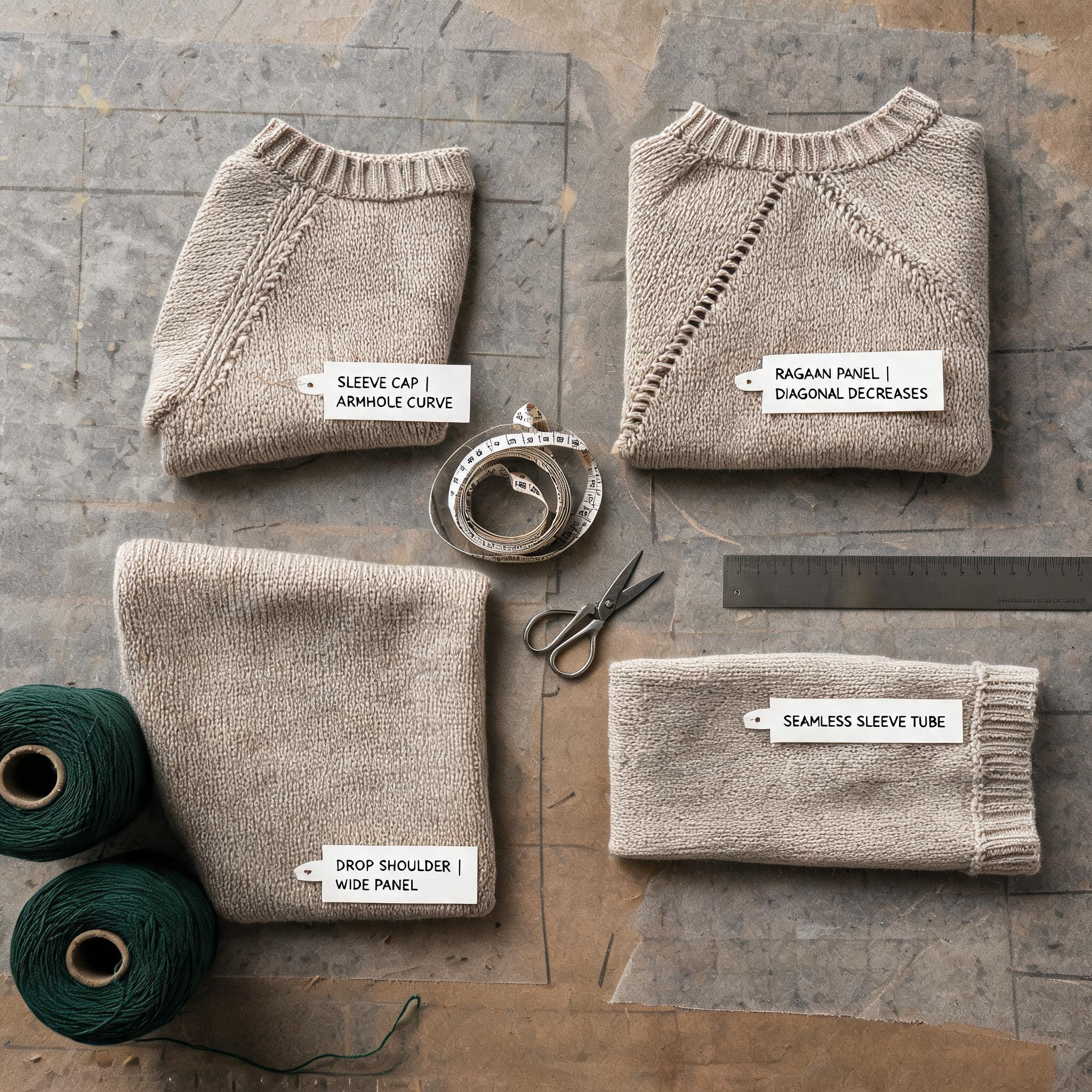
Four panels from four styles on the same bench: shaped sleeve cap, raglan decrease line, straight drop-shoulder body, and a seamless tube that never needed a seam at all.
Two knitwear styles can look identical on a mood board and be a different business on the machine. The difference is construction: how the body and the sleeve are made to meet, and therefore how much shaping, linking and fitting sits between the sketch and the carton.
This note compares the four constructions we run most often — set-in, raglan, drop shoulder and seamless — from the point of view of a buyer deciding what to develop. For each one: how it is actually knitted, what it does to the fit, where the cost sits, where it goes wrong in bulk, and what we need from you before a pattern is opened.
What the machine side is talking about this month
Two items worth a line each, because both land on construction rather than on print.
INDIA ITME 2026 opens on 4 December and runs to the 9th, and the needle makers are using it to talk about fine-gauge tooling — Groz-Beckert is exhibiting in Hall 14, Booth B6. Needles sound like a detail until you work at 16GG: at that density the difference between a good and a tired needle is a vertical line down a panel, and a needle line is the one defect no amount of pressing removes.
Separately, Hyosung and Santoni have been presenting bio-based elastane in seamless knitting. Seamless is the construction where the yarn and the machine cannot be discussed separately — the fibre has to hold the shape that the machine builds in, because there is no seam allowance left to correct it afterwards. It is also the construction buyers most often ask for by name without knowing what it removes from the pattern room.
One: set-in, the tailored option
A set-in sleeve has a shaped armhole on the body and a curved sleeve cap that is linked or seamed into it. It is the construction closest to tailoring, and the one that gives the cleanest shoulder line: the seam sits on the shoulder point, the sleeve falls from it, and the garment reads as fitted even at a relaxed body width.
How it is knitted: the armhole is shaped by full-fashion decreases — stitches narrowed course by course along a curve we calculate — or, on cheaper work, the panel is knitted straight and cut afterwards. The first gives a clean edge and no waste; the second is faster but leaves cut edges that must be secured, and the seam allowance eats into the fit.
Where the cost sits: shaping time on the machine and a second operation at linking. A set-in sleeve is two panels, a body and a pair of sleeves, and every one of them has an edge that must be joined accurately. It is also the construction that punishes a careless measurement sheet hardest, because the sleeve cap has to match the armhole curve — if the cap is 1cm short, the armhole puckers; if it is 1cm long, the shoulder droops.
Where it fails in bulk: at the armhole and at the sleeve head, in that order. Knits relax after washing, and a cap that fitted the armhole on the sample can open a gap at the underarm two washes later. We build the tolerance into the cap, not into the armhole.
Two: raglan, the diagonal
Raglan seams run from the underarm to the neckline, so the shoulder has no seam at all. On knitwear this is a generous construction: it flatters a wide range of bodies, it carries coarse gauge well because the diagonal gives the eye something to follow, and it is the natural choice for a garment that has to work across several sizes.
How it is knitted: decreases along a diagonal, mirrored on both sides, usually as a full-fashion line so the decreases read as a deliberate detail rather than a mistake. The decrease rate is the whole design: change it every second course and you get a narrow, sharp raglan; change it every fourth and the line flattens into something closer to a saddle shoulder.
Where the cost sits: less linking than set-in — often four seams instead of six — but more programming care, because a mirrored error is visible from across a room. Yarn consumption is slightly higher than a drop shoulder at the same body width, since the diagonal takes fabric out of the body and puts it into the sleeve.
Where it fails in bulk: at the neckline. A raglan neckline carries the whole weight of the garment, and a rib that was correct on the sample will open up after a few wears if the elastane in the neck yarn was not specified. Fix the neck yarn before you fix the neck width.
Three: drop shoulder, the rectangle
The drop shoulder is what most of the oversized knitwear in the market actually is: a body wider than the shoulders, with the sleeve set in a straight line below the shoulder point. Almost no shaping is required, which is why it is the cheapest construction on this list and the one that has carried the relaxed silhouette for several seasons.
How it is knitted: straight panels with a straight sleeve, joined at a right angle. On a coarse gauge the seam is deliberately visible; on a fine gauge it is pressed flat and disappears.
Where the cost sits: yarn, not machine time. The body is wider than the wearer, so a drop-shoulder style uses noticeably more yarn than a set-in at the same labelled size — and because it is usually knitted in a heavier gauge, the yarn bill is the number that moves the FOB. Machine time is the lowest of the four.
Where it fails in bulk: under the arm, where the extra body width folds into a bulk of fabric, and at the hem, which lengthens once the weight of the sleeve pulls on a relaxed stitch. If your fit is being sold as "one size", this is the construction to check, because "one size" is a fit decision, not a knitting one: the same pattern on a 3GG and a 12GG will hang completely differently.
Four: seamless, no seam allowance to hide in
Seamless — whole-garment knitting — builds the body and sleeves as one tube on a V-bed machine, with the joins knitted rather than sewn. No side seam, no sleeve seam, nothing to link. On the body it reads as a second skin, which is exactly why the shape has to be right in the program before the first sample exists.
How it is knitted: the machine narrows and widens the tube, splits it for the armholes, and knits the sleeves outward from the join. Programming is the development: there is no pattern to adjust afterwards, only a program to rewrite.
Where the cost sits: machine time and programming. A seamless garment occupies a machine far longer than a panel set, and grading means a separate program per size rather than a graded pattern. That is the honest reason a seamless style has a higher development cost and a narrower size range than the same silhouette made in panels.
Where it fails in bulk: at the underarm join, where the machine changes direction, and in the fit itself — because there is no side seam to let out, a body that measures 2cm tight cannot be saved at the finishing table. Seamless also constrains structure: openwork, intarsia colour blocks and heavy brushing all behave differently on a one-piece tube than on a flat panel, and some of them simply do not belong there.
The four constructions, side by side
| Construction | How it is knitted | What it does to fit | Cost driver | Where it fails in bulk |
|---|---|---|---|---|
| Set-in | Shaped armhole, curved cap, linked or seamed | Clean shoulder, closest to tailoring, holds a fitted line | Shaping time plus linking on six edges | Armhole puckering; cap opening at the underarm after washing |
| Raglan | Mirrored full-fashion decreases on a diagonal | Forgiving across sizes, strong on coarse gauge | Programming care; four seams instead of six | Neckline stretching if the neck yarn is underspecified |
| Drop shoulder | Straight panels joined at a right angle | Relaxed, oversized, hides shoulder width | Yarn — the widest body per labelled size | Underarm bulk; hem lengthening under sleeve weight |
| Seamless | One tube, joins knitted, sleeves grown from the body | Second-skin, no seam interruption | Machine time and a program per size | Underarm join; no seam allowance to correct a tight body |
What we can develop from a reference — and what we need to start
All four are routine for us between 3GG and 16GG, and a reference garment is a legitimate starting point. What makes the difference between a 48-hour quotation and a three-week exchange of emails is what arrives with the enquiry. For construction specifically, five things:
- Which construction the reference actually is. Photographs hide the armhole. A set-in and a drop shoulder can photograph identically on a hanger; send a photo of the garment inside out, or of the seam, and the question is answered.
- The body width at the underarm and the sleeve length from shoulder point — those two numbers tell us whether the silhouette can carry the construction you have chosen.
- Gauge, or the hand-feel you want if you have no gauge. Construction and gauge are decided together: a raglan at 3GG is a different garment from a raglan at 14GG.
- Quantity per colour, because the construction decides how much of the order is machine time and how much is linking — and those two scale differently.
- Where you want the fit to be adjustable. If the body may need letting out after the first fitting, say so; that single answer rules seamless out and set-in in.
If the reference works but the construction is the wrong one for your price, we will say so at quotation stage and quote the alternative. That conversation is much cheaper before a pattern exists.
Where the intellectual property line sits on construction
This is the part of development that buyers ask about most, and the answer is more comfortable than most people expect — with two exceptions.
Garment construction, as a technique, is not owned by anybody. A raglan sleeve, a drop shoulder, a full-fashion decrease: these are methods, and using them is not copying. That is why the shape of a garment is the least protected thing in fashion in most jurisdictions, and why a high-street version of a runway silhouette is ordinarily legal.
What is not open:
- Patented constructions. Some houses and some machine builders hold patents on specific ways of joining or finishing — bonded seams and certain seamless methods among them. If a reference depends on a patented join, we develop a different join rather than reproduce it.
- Trade dress. Construction combined with trim, colour, logo placement and packaging can become a brand identifier even when the technique is free. We will knit the shape; we will not reproduce the labelled garment.
The working rule is the same one we apply to drawings: re-development with a record. When we take a reference construction and rebuild it for your gauge, your yarn and your size range, we write down what changed and why, and it goes into the order file. That document is what makes a design claim answerable two seasons later — and it is also the fastest way to show a marketplace that a style was developed, not photographed and copied.
The three questions that decide the construction
Before a pattern is opened we ask: does the garment have to fit closely at the shoulder? Does the body need to be adjustable after the first fitting? And is the labelled size going to be a single relaxed size or a graded range? Set-in wins the first, set-in wins the second, drop shoulder wins the third — and if the answer to the second is yes, seamless is out.
How construction runs through the floor
The construction is decided in design, executed in the pattern room and proved in finishing, in that order:
- Design development — the construction is chosen against the gauge, the yarn and the target FOB, before a single panel is programmed.
- Pattern and sampling — the armhole, the cap and the decrease rates are calculated in stitch counts, and the first sample is knitted in the yarn that will actually run.
- Production and finishing — pressing and washing are what finally decide whether the armhole still sits where the sample said it did.
Our standard sequence: quotation within 48 hours of a usable pack, tech pack and yarn in 3–5 days, first sample in 7–10 days per round, bulk at 45–55 days after approval, at 300 pieces per style per colour, FOB Shenzhen or Guangzhou, full inspection to AQL 2.5.
Three questions we get asked
Which construction is cheapest?
Drop shoulder, and usually by a clear margin, because it is the least shaped. But cheapest to knit is not always cheapest to sell: if the style needs a shoulder line, the drop shoulder will cost you in returns instead. Set-in costs more at the machine and less in fitting.
Can you copy the sleeve from this photo?
We can read the construction from a photograph most of the time, and we will rebuild it for your gauge and your size range — that is development, not copying. We will not reproduce a patented join or a branded garment. A photo of the inside seam shortens the answer to a single email.
Does seamless mean no fitting problems?
The opposite. Seamless removes the seam allowance, which is the slack a pattern room uses to correct fit. A seamless body is either right or it is re-programmed. It suits second-skin shapes and fine gauges; it is a poor choice for a relaxed silhouette that may need adjustment.