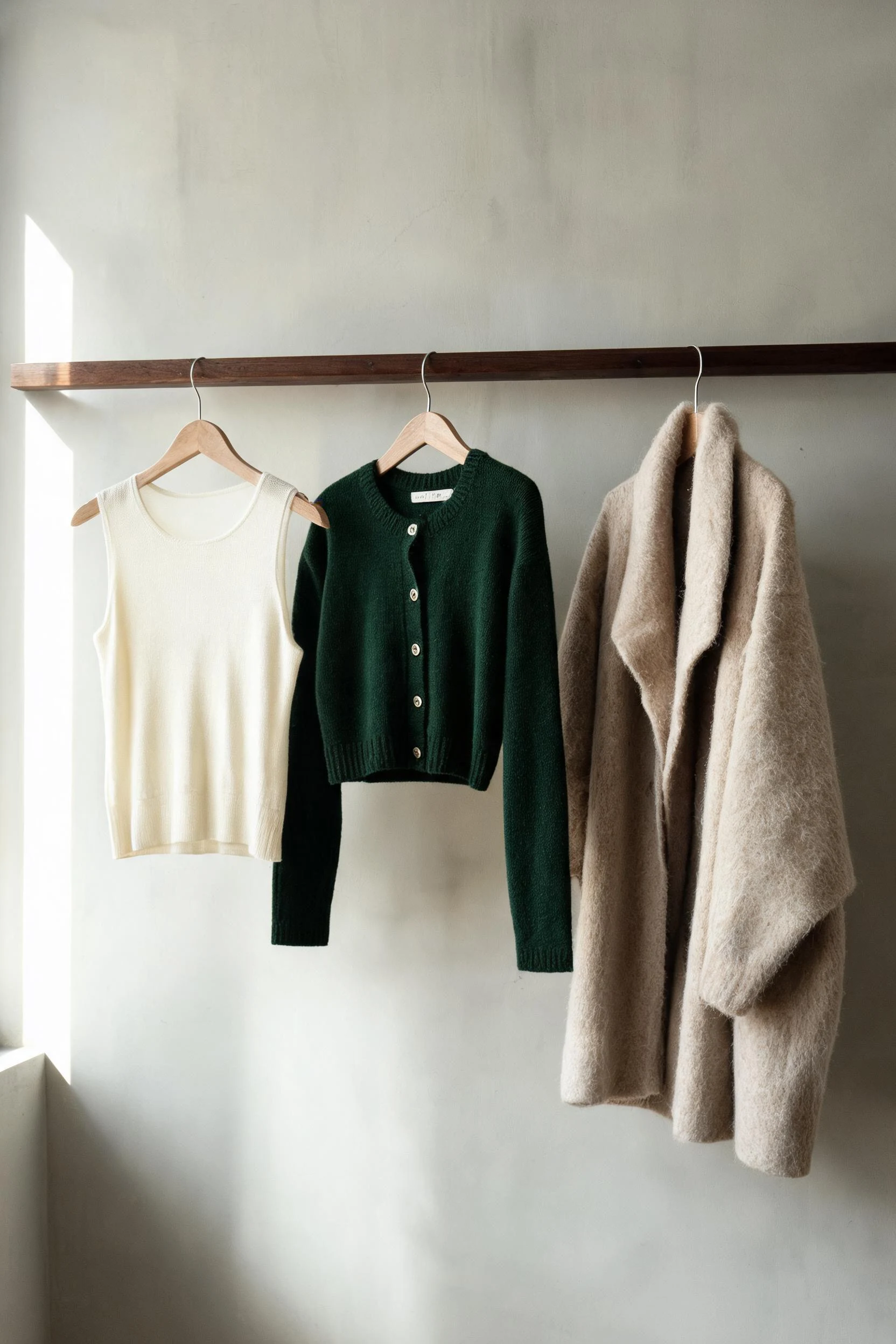
Three of the six, on the rail this week: a fine-gauge shell at 16GG, a cropped cardigan at 12GG, and a brushed outer layer at 5GG.
There is a shift in how knitwear is being bought, and it shows up in what lands on our sampling table. Two years ago a buyer would send one hero knit — a statement sleeve, a heavy cable, something to carry a range on its own. This month the folders are organised differently: a tight fine-gauge piece, a short cardigan to sit over it, and one generous outer layer that makes the whole thing look considered. Three weights, one wardrobe, one delivery window.
That change matters to a factory, because layered ranges are harder to schedule than single pieces. Each layer has its own gauge, its own yarn consumption, its own finishing risk — and they all have to arrive together and look like they came from the same hand. What follows is our internal review of the six silhouettes driving that work, written the way we would talk about them with a buyer sitting in the sample room.
Why layering won this season
Two pressures pushed it. First, retail is being planned in smaller drops with longer shelf life; a shell that works in three seasons outsells a statement knit that works for six weeks. Second, the fine-gauge piece is cheap to buy twice — the same body in two colours is a merchandising decision, not a design one, and buyers have learned to use it that way.
The counter-current is texture. Where volume is being bought at all, it is bought as surface: brushed, felted, cables at coarse gauge, ribs deep enough to cast a shadow. What is largely absent from the folders is the middle — medium-gauge novelty stitches that cost like a statement piece and read like a basic. That is a judgment from our own sample room, not a forecast, and it is the reason the verdict column below is blunt about which of the six we would spend sampling money on.
The six, one by one
1. The cropped button-front cardigan
Short body, set-in or dropped sleeve, five or six buttons, often with contrast tipping at the edge. It is the single most requested style in the folders right now, because it does the work of a jacket over a fine shell without the tailoring cost.
How we knit it: 12GG half-cardigan or plain with a 1×1 rib at the hem and cuff; buttons on a knitted or ribbon placket. Fully-fashioned panels if the shape is close to the body. Where the money goes: the placket and buttonholes — hand-set buttons and a clean buttonhole add minutes per piece that a plain pullover never carries, and the trims are a real line in the cost sheet, not a rounding. Where it goes wrong: a cropped body that is knitted, washed and then pressed without a fixed measurement point will grow 1–2cm at the hem and lose the proportion that made the style sell. Verdict: develop it, but lock the finished length after wash, not before.
2. The knit column dress
Straight or gently shaped, often sleeveless or with a short sleeve, worn as a base layer or alone. It is the piece that convinces a buyer a knit range can be a wardrobe rather than a knitwear corner.
How we knit it: 14GG–16GG fine gauge, viscose or merino blend for drape, fully-fashioned shaping at the waist and armhole so the dress holds its line without a lining. Where the money goes: machine minutes across a long panel and the fit rounds — a dress shows every error in the armhole and the bust point in a way a sweater does not. Where it goes wrong: fine-gauge viscose blends can go transparent over the hip when worn, and a dress that clings at the seat will be returned regardless of how good the sample looked on a hanger. Test on a body, in daylight, before you approve. Verdict: develop it, budget two fit rounds, and decide the opacity question with a real garment.
3. The zip-through funnel neck
A high collar, a half or full zip, a boxy body. It reads as outerwear, sells in unisex sizing, and is the easiest way for a women's brand to add a layer that is not a cardigan.
How we knit it: 7GG–12GG in milano, double-face or a firm plain; the collar is knitted with the body or linked on, and the zip is set into a faced placket. Where the money goes: the zip itself and the placket — a metal zip with a tape that matches the yarn is a visible cost, and setting it straight takes a skilled operator. Yarn consumption is higher than a pullover at the same gauge because of the collar and the double thickness at the front. Where it goes wrong: the zip pulls the front out of proportion if the placket is not stabilised; a wavy front on a flat-laid garment is the first thing a buyer sees. Verdict: develop it if you can commit to a zip quality — a cheap zip ruins an otherwise good knit.
4. The collared polo knit
An open collar, three buttons, a ribbed or flat-knit collar and cuff. It has replaced the plain crew neck in a lot of contemporary ranges because it photographs as a shirt and behaves like a knit.
How we knit it: 12GG plain body with a knitted collar, or a contrast-colour plating on the collar and placket; sometimes a fine ottoman rib for structure. Where the money goes: the collar — a collar that stands up after washing needs a denser structure and a firmer yarn than the body, which usually means a second yarn on the machine, and that is a cost decision made at development, not at bulk. Where it goes wrong: collars that collapse, and plackets that pucker where the button stand meets the body. Verdict: our favourite of the six on a value basis — the style looks more expensive than it costs, provided the collar is specified properly.
5. The brushed coatigan
A long, oversized, softly brushed layer worn open — half coat, half cardigan. It gives a knit range a piece of outerwear without a woven shell.
How we knit it: 3GG–5GG with a brushed or milled finish; sometimes a jacquard or a coarse rib for surface. Where the money goes: yarn — at this gauge a long body uses a serious quantity of it, and brushed yarns are less forgiving on price than they look. The finishing step is also a cost line of its own. Where it goes wrong: brushing and milling change the measurement after knitting, so a 110cm body can finish at 107cm; pilling becomes the customer complaint six weeks later; and a coatigan that is too light hangs like a blanket instead of a coat. Verdict: develop it only with a wash-and-wear test and an agreed pilling standard written into the order.
6. The fine-gauge layering shell
Sleeveless or short-sleeved, close to the body, often semi-sheer in a light colour. The cheapest piece in the range and the one that makes the other two layers make sense.
How we knit it: 16GG plain or a fine 1×1 rib, lightweight yarn, narrow linking at the shoulder and armhole; sometimes a second layer of yarn at the neckline for opacity where it matters. Where the money goes: almost nothing — which is exactly why it is worth doing properly. The cost sits in the yarn evenness and the finishing discipline, not in machine time. Where it goes wrong: at 16GG every slub, thick place and shade bar is visible; a lot that passed at 12GG will not pass here. Verdict: develop it, and approve the yarn from the actual dye lot rather than from a card.
The six, side by side
| Silhouette | Gauge | Structure | Cost driver | Main risk | Verdict |
|---|---|---|---|---|---|
| Cropped button-front cardigan | 12GG | Half-cardigan, rib hem, knitted placket | Placket, buttons, pressing | Length grows after wash and press | Develop; fix finished length after wash |
| Knit column dress | 14GG – 16GG | Fine-gauge plain, fully-fashioned shaping | Machine minutes, fit rounds | Opacity and clinging at the hip | Develop with two fit rounds |
| Zip-through funnel neck | 7GG – 12GG | Milano or double-face, faced placket | Zip quality, placket setting | Wavy front from an unstable placket | Develop only with a good zip |
| Collared polo knit | 12GG | Plain body, knitted or plated collar | Collar yarn and structure | Collar collapse, placket pucker | Best value of the six |
| Brushed coatigan | 3GG – 5GG | Brushed or milled, coarse rib or jacquard | Yarn weight, finishing | Shrinkage and pilling after finishing | Develop with a wash test |
| Fine-gauge layering shell | 16GG | Plain or fine 1×1 rib, narrow linking | Yarn evenness, finishing discipline | Visible slubs and shade bars | Develop; approve the actual lot |
Three decisions to make before you sample any of them
None of these is a design question, and all three change the quotation more than the sketch does.
- Does the layer have to sit next to a woven? If the cardigan will be worn over a woven shirt, the armhole and the sleeve length have to be built for it. A knit sleeve drafted for a knit body will bind over a woven one, and the fit complaint will arrive from the shop floor, not the sample room.
- How many colourways, and how many of them are light? Light colours on fine gauge demand better yarn and cleaner handling; a cream 16GG shell is the most expensive piece in the range to get right even though it is the cheapest to quote. Cost per colour, not cost per style, is the number to plan on at 300 pieces per colour.
- Which measurements are fixed by the design and which by the finishing? On a cropped cardigan the length is a design decision that finishing will quietly overrule. On a coatigan the whole silhouette is a finishing decision. Decide which is which, and write it into the measurement sheet with tolerances.
If we were building the range
We would spend the sampling budget on two pieces, not six: a 12GG cropped cardigan and a 16GG shell, in the same yarn family so the colours match exactly across both. That pair covers the layering story at the lowest development cost, and it leaves the coatigan for a season when you can afford a wash test and a proper pilling standard. The polo knit is the third piece we would add if the range needs a collared option — it is the one that most often converts a buyer who says they "don't wear knitwear".
Where silhouette meets the floor
A silhouette is only a drawing until three things happen in order. Skipping one of them is how a sample and a bulk order stop matching:
- Design development — gauge, yarn and target FOB are settled together, and the swatch is approved before a paper pattern exists.
- Pattern and sampling — the drawing becomes points of measure with tolerances; grading is done on stitch counts, and the first sample is tested on a body, in the yarn that will actually be used.
- Production and finishing — pressing, washing and brushing are held to the same standard on every lot, because on every one of the six silhouettes above, the finishing step is where the shape is finally decided.
The sequence in this factory is a quotation within 48 hours of a usable tech pack, tech pack and yarn in 3–5 days, a first sample in 7–10 days per round, and bulk at 45–55 days after approval, at 300 pieces per style per colour with FOB Shenzhen or Guangzhou. A layered range of three pieces is not three times the lead time, but it is three sampling tracks that have to be booked together — which is why the folders that arrive with the yarn decided move twice as fast as the ones that arrive with a mood board.
Three questions we get asked
Which of these is the cheapest way into a layered range?
The 16GG shell plus a 12GG cropped cardigan, in the same yarn family. Two styles, one yarn approval, one colour card, and the pair reads as a considered range on a shop floor. A coatigan is the piece to add later — it carries the highest yarn cost and the longest finishing conversation.
Can a knit column dress be lined?
It can, but lining a fine-gauge knit changes the drape that made you choose the style. The usual answer is a denser knit or a slightly heavier yarn at the areas that matter, plus a half-slip for the customer, rather than a full lining. We would rather solve opacity in the knitting than add a second process and a second delivery risk.
Do we have to sample every colour?
No — one sample per style is normal, with the colour card approved separately. What we do ask is that the light colours are approved on the actual yarn lot, because cream and ivory behave differently from navy at 16GG, and the difference only shows in the finished garment. If a colour is new to us, we would knit a swatch before the sample, not after.