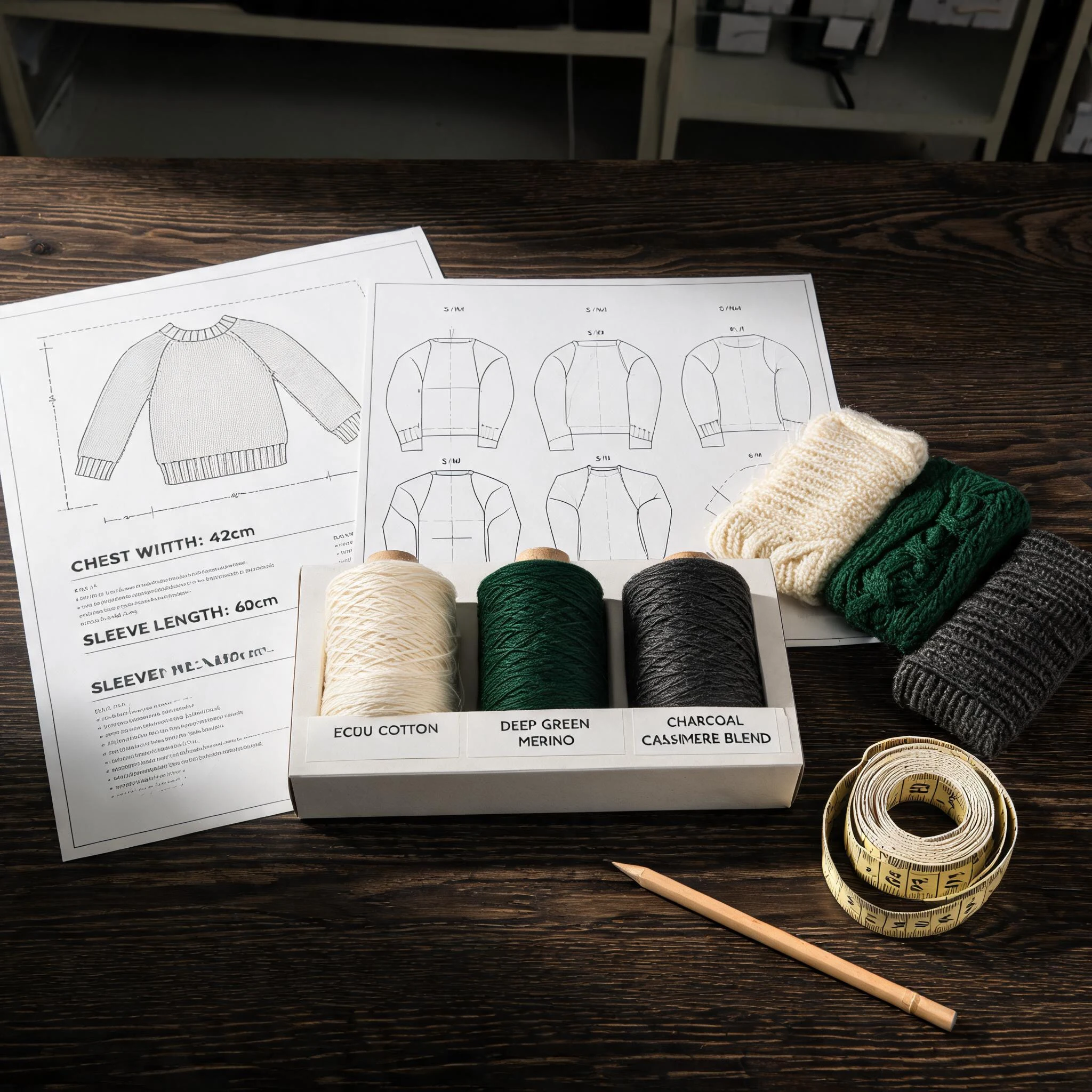
Pattern sheet, measurement call-outs and a yarn card — the three documents that decide whether a reference image can be manufactured.
Every development season starts the same way here: a folder of images arrives, some from a trend service, some photographed in a shop, some screenshots of a competitor's product page. The useful question is never "do you like it" — it is "which of these can we knit at your price, in your quantity, without copying anyone's property". Those are three separate answers, and they are the three sections of this note.
What is moving on the machinery side this month
Two things worth telling buyers about, because both change what a factory can promise at the development stage. ITMA Asia + CITME 2026 ran in Shanghai from 20 to 24 November, and the machinery makers used it to sell knitting machines, application development and digital tooling as one package rather than three purchases — which is how the better flat-knitting floors already work, ours included: a style is programmed, knitted and measured against the same file rather than reconstructed by eye.
Separately, Smartex.ai is launching an intelligent fabric-inspection system at SmartCollab in Hong Kong on 27 November, after private previews this month. Camera-based inspection at the machine means defect data arrives during knitting instead of at final inspection. For a buyer that is not a gadget story: it means a shade bar or a needle line can be caught in the first metres of a lot, when it is still a yarn or tension conversation, rather than after 3,000 pieces are packed. Digital tools do not replace the presser or the linker, but they shorten the loop between "the sample was right" and "the bulk was right".
Four directions we can develop now
1. Fine-gauge knits cut and sewn like jersey
A 14GG–16GG plain knit or narrow 1×1 rib, used as a body fabric with set-in or raglan sleeves and a woven-tape or rib neckline. This is the direction that keeps coming back in womenswear because it layers under tailoring and photographs cleanly.
What we need from you: the finished measurement spec, a yarn we can source or approve, and a decision on whether panels are knitted to shape (fully-fashioned, less waste, narrower design limits) or cut from yardage (cheaper at low volume, more trimming). Where it goes wrong: at 16GG the yarn is exposed — a slub that disappears in a 7GG knit shows on the surface — so the yarn has to be even, and the shade has to be approved from the actual lot.
2. Double-face, reversible and two-colour ribs
Double-knit structures with a different face on each side are having a good season, partly because they remove the lining question on jackets and cardigans. Two-colour ribs and ottoman ribs do similar work at lower cost: the structure, not the print, carries the design.
What we need from you: which side is the face, whether both sides must pass the same pilling standard, and the colour pairing (both colours must be available in the same yarn count and dye lot family). Where it goes wrong: a double-face panel uses close to twice the yarn of a single-face panel at the same gauge, and the pressing step decides whether the two faces stay flat. If the price was quoted from a single-face reference, it will not hold.
3. Fully-fashioned and whole-garment shaping
Panels knitted to shape and linked, or a garment knitted in one piece with the size built into the loop count. Both cut waste and cut labour, both are sold to buyers as a sustainability story, and both are worth doing for the right shape.
What we need from you: an honest silhouette. Simple, close-to-body or straight shapes work; anything that depends on drape, heavy texture or a dropped shoulder with a complicated armhole is better done as cut-and-sew. Where it goes wrong: programming time before the first sample is longer, and the cost curve does not always bend down at 300 pieces the way a cut-and-sew style does.
4. Textured and brushed outer layers
Cables, ottoman ribs, mixed-rib panels and brushed or milled finishes at 3GG–7GG. This is where a knit looks expensive for the least money, which is why it stays in every autumn range.
What we need from you: a swatch or a close-up photograph with light raking across the surface, an acceptance standard for pilling, and a shrinkage figure agreed before bulk. Where it goes wrong: the finishing step happens after knitting and can shift the fit — a milled panel can move two centimetres — so the measurement sheet has to allow for it rather than treating it as a surprise.
The style types, side by side
| Style type | Gauge | Main cost driver | Main risk | Our recommendation |
|---|---|---|---|---|
| Fine-gauge base layer (dress, tee, polo) | 14GG – 16GG | Machine minutes, yarn evenness | Visible yarn faults and shade bars | Develop now; spend on yarn before gauge |
| Double-face jacket or cardigan | 7GG – 12GG | Yarn consumption (roughly double) | Pressing discipline, colour pairing | Develop now for autumn |
| Two-colour rib knit | 5GG – 12GG | Colour count, feeds | Shade mismatch across lots | Good value; keep the palette to two |
| Whole-garment / fully-fashioned | 7GG – 14GG | Programming, limited structures | Shape limits, longer first sample | Simple silhouettes only |
| Textured or brushed outerwear | 3GG – 7GG | Yarn, machine speed, finishing days | Shrinkage and pilling after finishing | Develop now with a wash test |
| Knit body with woven or bonded panels | 12GG – 16GG | Two processes, one delivery date | Different shrinkage between panels | Only if the woven panel is specified early |
What a pattern file has to carry
"Send us the drawings" is where most development stalls. A flat sketch alone tells us the look; it does not tell us how to knit it. What actually opens a pattern is a pack with these parts, and the difference in the first sample is visible:
- Flat sketches, front and back, with the stitch direction marked — a knit skirt drawn with a vertical grain and a knit skirt drawn with a horizontal grain are two different styles.
- Points of measure with tolerances, not just a size chart. A chest width of 48cm with ±1cm tells us more than a size label.
- A graded spec across your size run — and the base size, because grading a knit is done on the stitch count, not by scaling a paper pattern.
- The stitch structure, drawn or described: plain, 2×2 rib, half-cardigan, links-links, tuck texture, transfer lace. A photograph is acceptable if the stitch is legible at close range.
- Yarn: composition, count and a reference swatch or cone. "Soft cotton" is not a yarn; 2/48NM combed cotton is.
- Gauge, or the desired hand and weight if you do not know the gauge yet — we will propose one.
- Trims and finishing: neckline tape, buttons and their size, linking versus overlock, wash and press instructions, and the label placement.
- Colourways and quantities per colour, because that number, not the total, is what the price and the schedule are built on.
Ownership matters as much as content. Tech packs, patterns and approved samples developed for a buyer stay with that buyer: we do not reuse them for other customers, we do not show your style to another brand, and we do not re-sell another factory's capacity as ours. That is a promise we can only keep if we know which documents came from you and which we generated.
The IP line: five rules we hold
Design infringement is not an abstract legal topic in this trade. It shows up as a message from a marketplace, a customs hold, or a brand's lawyer writing to a factory. We would rather lose a sample order than knit something we cannot defend, so these five rules are applied before programming, not after:
1. No logos, characters or trademarked prints without written authorisation
Company logos, brand names, cartoon and game characters, team crests and signature prints are licensed property. If the artwork contains one, we need the authorisation letter from the rights holder before we knit a sample — not a promise that it will arrive before bulk. This applies to a single woven label as much as to an all-over jacquard.
2. "Inspired by" is done by re-development, not by tracing
Working from a reference is normal and legitimate: designers do it all day. What we will not do is reproduce a garment one-to-one. The re-development changes the silhouette, the proportions, the stitch structure, the trim and the colourway, and we record what changed. There is no legally safe percentage to change — anyone who quotes you one is guessing — but a documented re-design with a different construction is a defensible position, and a traced copy is not.
3. Your design is protected on our floor too
Patterns, tech packs, machine programs and approved samples belong to the buyer who paid for them. They are not reused between customers, and a style developed for you is not offered to another buyer. If your design is the one being copied, this is the clause that matters.
4. Ask where the artwork came from
Jacquard, intarsia and printed panels all start as an image file. Ask the designer for its provenance: a bought stock illustration, an in-house drawing, a scan of a vintage textile, or an AI-generated image. AI output needs the same scrutiny as anything else — a model can reproduce a protected pattern closely enough to be a problem — so the file's origin should be written down before it goes to the programming stage.
5. Say no early, and offer the alternative
When a buyer sends a photograph of a recognisable branded product and asks for "exactly this", the answer is a re-developed version with the protected elements removed, quoted honestly, with the differences listed. When the request is for a licensed property, the answer is the authorisation letter first. Both conversations are cheaper at the quotation stage than at the container stage.
What to send with a reference image
The image, plus: which part you actually want (the stitch? the fit? the finish?), the target FOB and quantity per colour, the season and delivery window, the yarn you can approve, and whether any element on the garment belongs to another brand. With those five, a quotation is a calculation. With only the image, it is a guess that gets corrected at your expense.
Where design and manufacturing meet
None of the four directions above is decided in a lookbook. Each is settled in three places, and skipping one is how a sample and a bulk order stop matching:
- Design development — swatch, yarn, gauge and target FOB are decided together, before the first sample is knitted.
- Pattern and sampling — gauge becomes measurements; the stitch, the shrinkage and the finishing are tested on the actual yarn.
- Production and finishing — pressing discipline, wash results and the pilling standard are held on every lot, not only on the first.
The usual sequence here is a quotation within 48 hours of a usable pack, tech pack and yarn in 3–5 days, a first sample in 7–10 days per round, and bulk at 45–55 days after approval, at 300 pieces per style per colour. Anyone who quotes a shorter path either has a different yarn already on the shelf or has not costed the sampling rounds.
Three questions we get asked
Can you make an exact copy of this photo?
We will make a version of it, not a copy. We re-develop the silhouette, stitch and trim, keep the commercial intent, and list what we changed so you can see the difference. If the photo shows a licensed character, a brand logo or a signature print, we need written authorisation from the rights holder before sampling.
Do we own the patterns you make for us?
The tech pack, the pattern and the approved sample developed for your order stay yours, and they are not reused for another customer. What stays with us is the machine program and the production know-how built for our machines — that is what we would use to knit your re-order, and it is why a repeat order is faster than a first one.
What if we only have a sketch and a mood board?
That is workable. We will propose the gauge, the yarn and the stitch structure, knit a swatch for approval, and only then open the pattern. It adds one round to the schedule, but it is usually cheaper than opening a full pattern on an unresolved stitch.