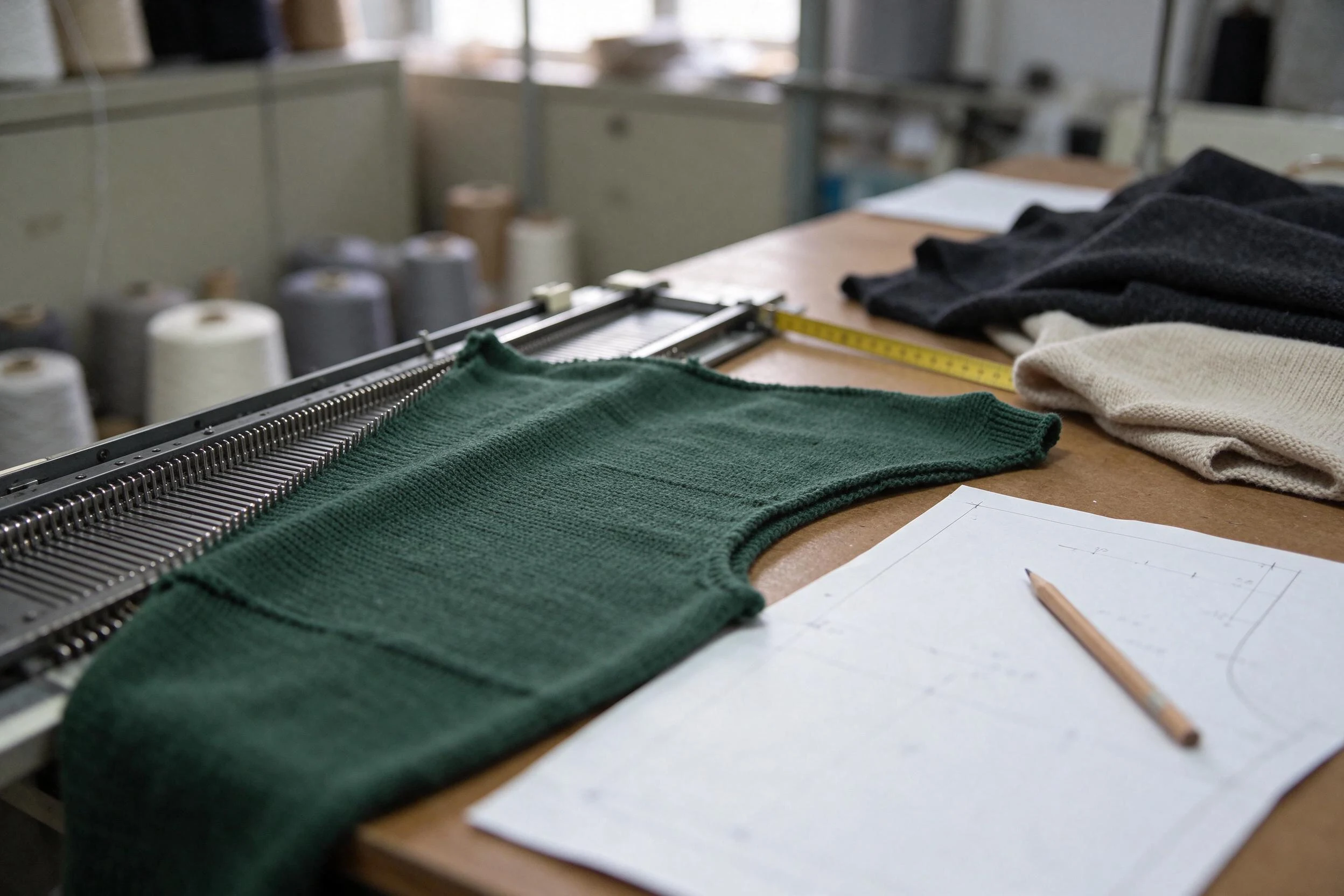
A panel still on the needles, and the sheet that is supposed to match it. Most of what goes wrong between them is one of the five decisions below, taken by default instead of on purpose.
We get asked one question more than any other: can you make this? It arrives with a sketch, a photo of a rail, a garment bought in Tokyo, or a 3D render that has never been near a yarn. The answer is almost always yes — but which yes matters, because there are five ways a knitwear design reaches the machine, and each one leaves a different garment, a different cost and a different failure at bulk.
This note takes the five decisions in the order they are actually taken: how wide the bed is, how the panel is shaped, how long the loop is, how the panels are joined, and how much the cloth moves after it is washed. Take them out of order and you spend the sampling budget finding out what a needle bed already knew.
What the trade is writing about this month
The manufacturing pages of the knitting press this month are not about styling. They are about construction: a hydration vest whose body, pockets and openings are knitted in one piece with no cutting and no sewing; warp-knit development being pushed into a fourth dimension of structure; machine makers presenting their design platforms at the winter fairs; and the trade shows already laying out next season's fibre and yarn direction for January.
Read together, the direction is consistent. The interesting work is moving away from "knit a panel, then cut it and sew it" towards "knit the garment". That is good news for a factory like ours, because it is the part of the trade we have always been set up for — but it also means a design has to arrive as a set of making decisions rather than as a picture, because there is far less room to correct afterwards.
One: needle count — the bed is the first limit
A flat knitting machine has a fixed number of needles across its bed, and the panel cannot be wider than they allow. Our beds run from 3GG brushed yarns up to 16GG fine jersey, and the finer the gauge, the more needles per centimetre — so a fine-gauge bed can knit a wider panel at the same needle count. Say it plainly: on a coarse gauge, a wide, long garment runs out of bed before it runs out of anything else.
Where the cost sits: if a body is wider than the bed, it is split into two panels with a centre seam, and that seam is a cost, a bulk failure point and a design change all at once. A grown-on sleeve or a full-width intarsia block makes the same problem worse, because both need the panel at its widest at the point where you also want the pattern intact.
Where it fails in bulk: a panel knitted at the very edge of the bed has less tolerance for yarn variation, so width drifts between lots; and a garment split to fit the bed ends up with a centre-front seam that the flat drawing never showed, which is the sort of detail a buyer discovers at the fit session.
What we need from you: finished measurements at the chest, hem and sleeve, plus the gauge you want. From three numbers we can say whether it fits one bed or two panels — and that answer arrives before the sample, not after it.
Two: shaping — knitted to shape, or cut out of a panel
There are three ways to get a shaped knit and they are not equivalent. Fully-fashioned panels are knitted to the shape, with the decreases placed where the armhole and neckline will be, and the fashioning marks left visible or pressed away. Cut-and-sew knits a rectangular panel and cuts the shape out of it, which is faster and wastes yarn at every curve. Whole-garment knits the tube in one piece and needs no join at all, which is the neatest answer and the one with the least room for error.
Where the cost sits: fully-fashioned is slower on the machine and needs a program per size, but it saves yarn and saves the seam. Cut-and-sew is cheapest per panel and the most expensive in waste — on a deep armhole a good third of a panel can end up on the cutting-room floor. Whole-garment is a different machine, a different program and a much higher minimum.
Where it fails in bulk: on cut-and-sew, cut edges that curl or run if the panel is not stabilised before it is cut, which shows first at the armhole; on fully-fashioned, fashioning marks landing in the wrong place after a size correction, so the shoulder line reads unevenly across a run; on whole-garment, a drop in one feeder that stops the entire tube.
What we need from you: a decision, not a preference. "Knitted to shape" and "cut and sewn" give different armhole curves on the same drawing, and the difference is visible on a body at the first fitting.
Three: stitch length — the same yarn is two different cloths
Stitch length is how much yarn goes into each loop. Change it and the same yarn, on the same gauge, becomes a different fabric: tighter loops give a denser, heavier, stiffer cloth that holds a shape; longer loops give a lighter, softer, more fluid cloth that drapes and grows. This is the decision that most often makes a sample feel wrong while the measurements are perfect.
Where the cost sits: a longer stitch length uses less yarn and runs faster, so it is cheaper per panel and more expensive per season — because a cloth that stretches and pills gets sent back. A tighter cloth costs more yarn and more machine time, and holds its shape through twenty washes.
Where it fails in bulk: a cloth knitted too loose loses its width after the first wash and the body reads a size larger than the chart; a cloth knitted too tight on a soft yarn comes back with a boardy hand that no amount of softening brings back; and a stitch length changed between the sample and bulk to hit a price is the single most common reason a re-order "feels different from the first one".
What we need from you: the hand you want in plain words — fluid, dry, compact, brushed — plus the weight you are targeting in grams per square metre. We will knit a swatch at two stitch lengths and send both; choosing from the two is faster than describing the third.
Four: the join — linked, seamed, or nothing at all
Panels have to become a garment. Linking joins stitch to stitch on a linking machine, which is the cleanest and the only way to keep a seam elastic; overlock or flatlock sews the panels together, faster and heavier, and visible on the inside; and whole-garment removes the question by having nothing to join.
Where the cost sits: linking is skilled hand-fed work, one operator per seam, and it is the labour line that surprises buyers most on a fully-fashioned garment. On a raglan there are four seams, on a set-in sleeve six, and each one takes time that does not shrink with order size the way cutting does.
Where it fails in bulk: a linked seam that is pulled too tight and shows a ridge down the armhole, most visible on a light colour; an overlocked seam on a fine gauge that hardens the edge and stops the cuff stretching; and a seam placed where the panel was cut rather than where the pattern was shaped, so the join runs off the fashioning line.
What we need from you: whether the inside will be seen — it decides linking versus a neatened overlock faster than any price sheet — and whether any seam sits under a print, a pattern or a pocket, because the seam is planned before the panel is knitted.
Five: relaxation and finishing — the measurements move after approval
Knitted cloth is under tension on the machine and relaxes afterwards. Wash it and it can move two to six per cent, in both directions, depending on the yarn, the stitch length and the finishing route. This is not a defect; it is a property. The problem is that the sample is measured before the wash and the bulk is measured after it.
Where the cost sits: a wash test and a shrinkage trial before the size chart is signed off, which is a line in the quotation and a week on the calendar. Skipping it does not save either; it moves the cost to the second bulk, where the corrections are already cut.
Where it fails in bulk: a body that loses 4% in length and reads short at the hem; a sleeve that grows and drops past the wrist; a print or an embroidery placement that was measured on a flat panel and sits a centimetre and a half lower after relaxation; and a fully-fashioned garment measured flat at inspection, then measured again by the buyer on a hanger, with two different results.
What we need from you: your measurement tolerance, and whether the chart describes the garment flat, relaxed, or after three washes. All three are legitimate; a chart that does not say which one is the one that fails.
The five, side by side
| Decision | The options | Cost driver | Where it fails in bulk |
|---|---|---|---|
| Needle count | One panel within the bed, or two panels with a centre seam | Bed width per gauge; a seam adds labour and a design change | Width drifting between lots; a seam the drawing never showed |
| Shaping | Fully-fashioned, cut-and-sew, whole-garment | Machine time and programs versus yarn waste; whole-garment needs its own machine | Curling cut edges; fashioning marks off the line; one feeder stopping the tube |
| Stitch length | Tight and compact, or long and fluid | Yarn consumption and machine speed, against return rate | Width lost after wash; boardy hand; a re-order that feels different |
| The join | Linking, overlock or flatlock, or no seam at all | Skilled linking per seam — four to six on a sleeved body | Ridged armhole seam; hardened cuff; seam off the fashioning line |
| Relaxation | Wash test and shrinkage trial, or hope | A wash trial before the chart is signed | Length lost at the hem; placement drifting; two different measurement methods |
One-piece knitting: what the trade is showing, and what we can run
The most interesting garment in this month's trade press is a hydration vest knitted in one piece, with the pockets and openings built into the fabric — no cutting, no sewing, ready off the machine. It is a good example to hold up, because it shows where the technology actually is: not floating, but reducing parts.
What we can do now, on the beds we have: knit a body in one piece where the shape allows, knit pockets and plackets into the panel instead of sewing them on, knit a full-width panel to shape so there is less to cut, and set a whole-garment program on the machines that support it. What we will say plainly is out of reach: a three-dimensional garment with underarm gussets and multi-layer panels on a standard bed, in a first order of a few hundred pieces. It exists; it is not where a first season should start.
The practical version of the trend is smaller than the headline and more useful: fewer parts, fewer seams, more of the design decided in the program. A cardigan with a knitted-in placket and knitted-in pockets has three fewer operations than the same cardigan built the conventional way — and every operation you remove is a failure you no longer have.
Three directions we can develop this season
From the drawings and reference garments that came through the sample room this month, three are worth taking to a swatch rather than straight to a sample:
- A one-piece body with a knitted-in pocket. The shape is simple enough to knit in one piece on a mid-gauge bed; the pocket moves from an operation to a program. Best on 7GG–12GG, and it needs one program per size.
- A fully-fashioned sleevehead with a visible fashioning line. The marks are the design: they show the shaping instead of hiding it. It suits a dry, compact cloth and dislikes a brushed yarn, where the marks disappear into the surface.
- A long, fluid column knit with a short seam and a wide rib hem. The cloth does the work and the making is minimal — but the whole style depends on getting stitch length and relaxation right before the chart is signed, because there is no seam to correct a measurement with.
What we will not do is take a reference garment and reproduce it. Every one of the three directions above has been made by somebody before, in some version; the work is to redraw it to your gauge, yarn and quantity, and to document what changed. That is the difference between development and copying, and it is the next section.
What to send with a development enquiry
- Finished measurements at chest, hem, sleeve and body length, and the tolerance you will inspect against.
- Gauge and yarn you have in mind, or the hand you want if you do not. A gauge range is enough to start; a yarn count and count system is enough to quote.
- Shaping route, if you have a view: knitted to shape, cut and sewn, or one piece. If you do not, say so — we will recommend one and tell you what it does to the price.
- Seam and inside treatment: linked, overlocked, or bagged out. This decides a labour line worth twenty per cent of the make on some styles.
- Quantity per style and per colour, and whether colours will be added later, because that decides how the programs are written.
- Where the reference came from. Your own archive, a licensed design, or a garment bought on a trip. The third answer changes the whole conversation, and it is better had before the swatch.
Where the IP line sits on a garment shape
Construction is the area where buyers worry least and should worry more, because a garment's shape is easier to register than a print and easier to recognise on a rail.
What is open:
- The technique itself. Fully-fashioned shaping, linking, whole-garment knitting and knitted-in pockets belong to nobody. Using the same method as a reference garment is not copying.
- Generic construction classes. A set-in sleeve, a raglan, a drop shoulder, a crew neck, a rib hem. These are the vocabulary of the trade.
- Your own re-development. When we redraw a reference to a defined set of changes — gauge, proportion, stitch length, seam route, trim — the result is a new garment with a documented reasoning behind it.
What is not open:
- A registered design on a garment shape. Some silhouettes and some distinctive constructions are registered in the markets they sell in. We will not reproduce one, and we would rather say so at the swatch than at the second sample.
- A brand's signature construction. When a shoulder line, a seam position and a trim exist only as one house's garment, the combination is not a generic class, whatever the individual parts are.
- Another brand's pattern file or 3D model. A pattern is a document with an owner. Copying the file is the clearest case there is.
- Trade dress. Construction plus colour plus trim plus label, read together on a shelf, can identify one brand even when each element is free on its own.
Our practice is the documented re-development: what changed, why, and which reference it started from, filed with the approved swatch and the measurement chart. It costs an hour at the start and answers the whole question two seasons later — and it lets you move the style to a second supplier without losing the reasoning.
Three questions before the first swatch
Does this garment fit one bed? Is the shape knitted, cut, or knitted whole? And whose shape is it? The first decides whether there is a centre seam; the second decides where the cost and the risk sit; the third decides whether it ships at all. In our experience none of the three is answered on the flat drawing — and all three are cheaper to answer in the sample room than in the second bulk.
How a development runs through the floor
A knitwear style is decided in design, proved in the pattern room and settled on the finishing line:
- Design development — gauge, shaping route and stitch length are fixed against the quantity before the quotation, not after the first sample.
- Pattern and sampling — the program, the size grading and the wash trial are set here, and the first sample is knitted in the real yarn.
- Production and finishing — linking, wash, measurement and inspection decide whether the garment that ships is the one that was approved.
Our standard sequence: quotation within 48 hours of a usable pack, tech pack and yarn in 3–5 days, first sample in 7–10 days per round, bulk at 45–55 days after approval, at 300 pieces per style per colour, FOB Shenzhen or Guangzhou, full inspection to AQL 2.5.
Three questions we get asked
Can you knit this in one piece?
Sometimes, and the answer is decided by the shape rather than by the machine. A straight body with a knitted-in pocket and a simple neckline: yes, on a mid gauge. A fitted garment with armhole shaping and a set-in sleeve: that is a whole-garment program, a different machine and a much higher minimum. We will tell you which one you are asking for at the first review, because the two have nothing in common commercially.
Why did my sample come back the right size but the wrong hand?
Almost always stitch length. The measurements are set by the program and the gauge; the hand is set by how much yarn is in each loop. Change the loop and the cloth becomes denser or more fluid without a single measurement moving. That is why we knit two swatches at two stitch lengths on a first development — the second one is cheaper than a second sample.
Can we copy this garment we bought?
Not the garment, and not its pattern file. We can develop from it: a documented set of changes to gauge, proportion, cloth and trim, so the result is your style with a record behind it rather than a reproduction. If the shape is a registered design in your market, we will say so at quotation — and we would rather lose the order there than at the second sample.