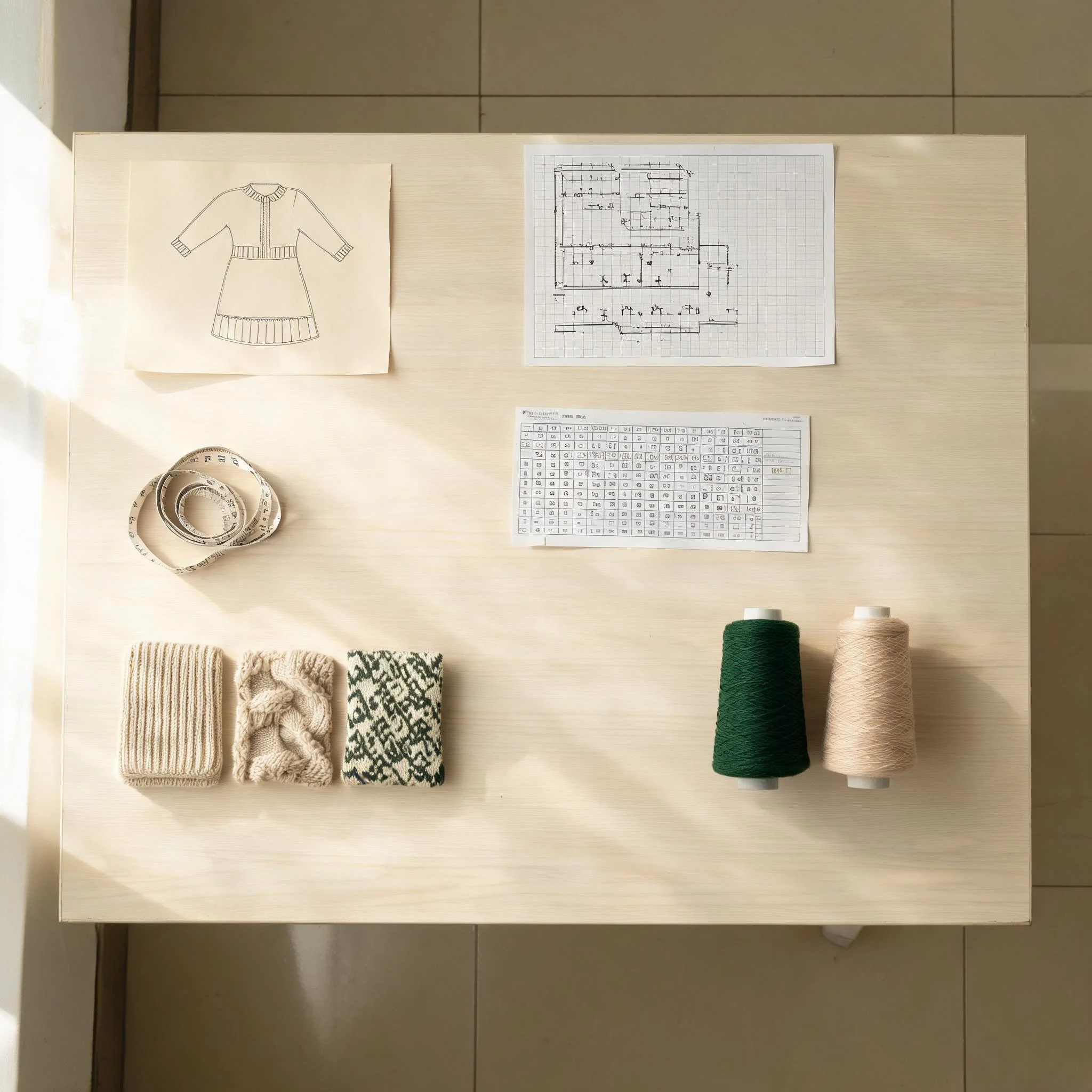
The same style in three documents: a flat, a stitch diagram on graph paper, and the needle-bed program it will be knitted from.
Most development problems we see are not design problems. They are translation problems. A sketch shows a shape; the machine needs a sequence of needle movements, once per course, several hundred courses per panel. Between those two things there are three more drawings, and every one of them is a place where a good idea can quietly become a different garment — or a legal letter.
This note walks through the four drawings in the order they are made on our floor, with the question each one is really answering. It is written for buyers who have been told "send the drawings" and were not sure which drawings were meant.
What changed on the machine side this month
Two things worth flagging, because both shorten the distance between a drawing and a bulk order.
ITMA Asia + CITME 2026 is running in Shanghai from 20 to 24 November, and the machinery makers have been presenting knitting machines, application development and digital tooling as a single package rather than three purchases — Shima Seiki on the flat-knitting side, Santoni on circular. That framing is not marketing: on a floor that works this way, a style is programmed, knitted and measured against one file instead of being reconstructed by eye from a paper pattern. It is also why the second drawing below matters more than it used to.
Separately, Smartex.ai is putting its fabric-inspection system in front of the industry at SmartCollab in Hong Kong on 27 November, after private previews from 19 November. Camera-based inspection at the machine moves defect data into the knitting stage instead of final inspection. For a buyer the practical consequence is narrow but real: a needle line or a shade bar gets caught in the first metres of a lot, while the fix is still a yarn or tension decision, rather than after the panels are cut.
Drawing one: the flat, which cannot be graded like a woven
The flat is the design drawing, and it carries less information than buyers expect. What matters on it is not the rendering quality but three things: the silhouette as a set of finished measurements, the stitch direction, and which seams exist.
Stitch direction is the one that gets skipped. A skirt drawn with vertical ribs and a skirt drawn with horizontal ribs are two different styles with two different pattern sets; a sleeve drawn on the bias is a third. If the flat does not mark grain, the factory will choose for you, and it will choose the cheaper option.
Grading is where a knit really departs from a woven. A woven pattern is graded by moving seam lines a few millimetres per size; a knit is graded by changing stitch and course counts, because the panel is knitted to shape rather than cut from cloth. Scale a knit pattern the way you scale a woven one and the garment will be right at the base size and wrong at both ends of the run — usually at the armhole and the neck width first. That is why the flat has to arrive with a graded spec and a declared base size, and why we ask for tolerances on the measurement sheet rather than a single number per point.
Drawing two: the stitch diagram, where one square is one needle
This is the drawing buyers most often cannot read, and the one that decides whether a surface is achievable. On graph paper each square is one needle in one course. Since gauge is needles per inch, the paper has a fixed scale: at 12GG a motif 5cm across is roughly 24 squares wide. At 3GG the same 5cm is about 6 squares — which is why coarse-gauge jacquard can only carry large, blocky shapes, and why a fine logo drawn for print becomes a blur when it is pushed onto a 5GG machine.
Three structures, three different demands on this drawing:
- Jacquard — colours are carried across the back as floats. Long floats snag and pull, so a design with isolated dots needs the extra yarn tucked in, and every added colour costs machine time and yarn. Two-colour jacquard at 12GG is routine; five colours in one course is a different quotation.
- Intarsia — separate yarn carriers per colour block, no floats at all. It carries large colour areas beautifully and hates small ones: every colour change is a carrier change, and a scattered motif turns into a slow, expensive knit.
- Transfer lace and openwork — stitches moved to neighbouring needles to create holes and lean. The diagram has to say which way each eyelet leans; get the transfers mirrored on one panel and the garment looks hand-made for the wrong reason.
What we do with it: a technician redraws the motif on the correct gauge grid, checks the repeat divides into the panel width, and knits a swatch. If the motif only works at a gauge the style cannot use, we say so at this stage — before a pattern is opened, not after the first sample.
Drawing three: the needle-bed program
Nobody sends us this one; we generate it. It is the file the machine actually runs: needle selection per course, transfers and tucks, takedown tension, waste and drawthread, and the linking allowance at each edge. It is also where a good portion of the factory's know-how lives — how a particular yarn behaves at a particular tension, which structure needs a slower run, where a panel has to be steamed before linking.
That has a consequence for ownership, and it is the part buyers ask about most: the tech pack, the pattern and the approved sample developed for your order are yours and are not reused for another customer. The machine program is the factory's, built for our machines; it is what makes your re-order faster than your first order. If you move production, you take the pattern and the spec, and the next factory will build its own program from them. That is normal in this trade, and it is worth knowing before a conversation about "who owns the file".
Drawing four: the bulk chart that closes the loop
The last drawing is the least glamorous: the chart of what actually came off the line, measured against the spec, after washing and pressing. On knitwear this document is not paperwork — it is the only evidence that the drawing survived contact with finishing.
A brushed or milled panel can move two centimetres in the finishing step. A cropped body pressed without a fixed measurement point grows 1–2cm at the hem. A 16GG shell that measured perfectly flat can relax half a size after a wash. If the tolerance on drawing one did not allow for any of this, the bulk chart will show a garment that is technically to spec and commercially wrong. So the rule we work to is simple: decide which measurements are set by the design and which are set by the finishing, and write both into the sheet before the first sample, not after the third.
The four drawings, side by side
| Drawing | Who makes it | What it must carry | Where it fails |
|---|---|---|---|
| 1. Flat sketch | Buyer / designer | Silhouette, stitch direction, seams, graded spec, base size, tolerances | Missing grain line; graded like a woven; one number per point with no tolerance |
| 2. Stitch diagram | Buyer, redrawn by factory | Motif on the gauge grid, repeat division, structure type, colour sequence | Detail finer than the gauge can hold; floats too long; transfers mirrored |
| 3. Needle-bed program | Factory | Needle selection per course, takedown, waste, linking allowance | Tension not adjusted to the yarn; program reused across a yarn change |
| 4. Bulk chart | Factory, checked with buyer | Measured garment after wash and press, against spec and tolerance | Tolerance set before finishing behaviour was known |
Where the copy line sits, drawing by drawing
"Can you develop this?" and "can you copy this?" sound like the same question and are not. Here is how the line is drawn at each of the four stages, which is also how we explain a refusal to a buyer who has sent a folder in good faith.
- On the flat: a garment's shape is, in most jurisdictions, the least protected thing in fashion — that is why high-street versions of a runway silhouette are legal almost everywhere. What is not open is trade dress that has become a brand identifier, and the specific construction patents some houses hold. We will develop a silhouette; we will not reproduce a branded garment down to its trim and label.
- On the stitch diagram: this is the highest-risk drawing, because a motif is a work of authorship. A pattern taken from another brand's knit, a scan of a vintage textile, an illustration pulled off the internet, or a character is protected the moment it is fixed — registration only makes it easier to enforce. We ask where the motif came from and we record the answer before the swatch.
- On the reference photograph: the photograph itself belongs to whoever took it. Using it to describe a fit or a finish is ordinary practice; scanning its print into a jacquard is copying the photographer's image and the print at once. Describe what you want in words, or send your own artwork.
- On the program and the archive: our programs stay ours and are never reused for another buyer. Your patterns, tech packs and approved samples stay yours. A style from your own archive is your IP to re-run — that is the safest place to start a season, and the cheapest.
There is no legal percentage of change that makes a copy safe, and any supplier who quotes you one is guessing. What is defensible is a documented re-development: different stitch structure, different proportions, different trim, and a written record of what changed. We keep that record as a diff sheet with the order file, so that if the question ever arrives from a marketplace or a customs office, the answer is a document rather than a memory.
What a diff sheet looks like
One page, four columns: what the reference has, what we changed, why, and who approved it. Silhouette, stitch, gauge, yarn, trim, colourway, artwork. It takes twenty minutes at development and it is the only piece of paper that helps if a design claim appears two seasons later. It also makes the next style easier to develop, because the reasoning is written down.
How the drawings run through the floor
A drawing only becomes a garment when three departments handle it in order. Skipping one is how a sample and a bulk order stop matching:
- Design development — the flat is turned into a gauge, a yarn and a target FOB, and the motif is checked against the gauge grid before any pattern exists.
- Pattern and sampling — the stitch diagram becomes points of measure with tolerances, grading is calculated in stitch counts, and the first sample is knitted in the yarn that will actually be used.
- Production and finishing — pressing, washing and brushing are held to the same standard across every lot, because on knitwear the finishing step is where the drawing is finally obeyed or quietly overruled.
The sequence here is a quotation within 48 hours of a usable pack, tech pack and yarn in 3–5 days, a first sample in 7–10 days per round, and bulk at 45–55 days after approval, at 300 pieces per style per colour with FOB Shenzhen or Guangzhou. Inspection is AQL 2.5 on a full check. A folder that arrives with a graded spec, a gauge and a motif source moves noticeably faster than one that arrives with a mood board — not because we work harder on it, but because there is nothing left to guess.
Three questions we get asked
Can you knit directly from a photograph?
We can read a photograph for shape, proportion and surface, and we will propose the structure. We cannot scan it and knit it: the photo is someone's image, and the stitch it shows has to be rebuilt as a diagram at your gauge. Expect one swatch round before the first sample if the surface is unusual.
Why can't you just use our woven pattern?
Because a knit panel is knitted to shape. A woven pattern tells us a finished outline, but the machine needs stitch and course counts, and the rib, the linking allowance and the finishing shrinkage all move those counts. We use the woven pattern as a reference for measurements, then build a knit pattern beside it.
What do we need to send for a first quotation?
Four things: a flat with stitch direction, a size spec with a base size, the gauge (or the hand-feel you want if you have no gauge), and quantity per colour. A motif or a yarn reference helps and shortens the round, but those four get you a real number rather than a range.