
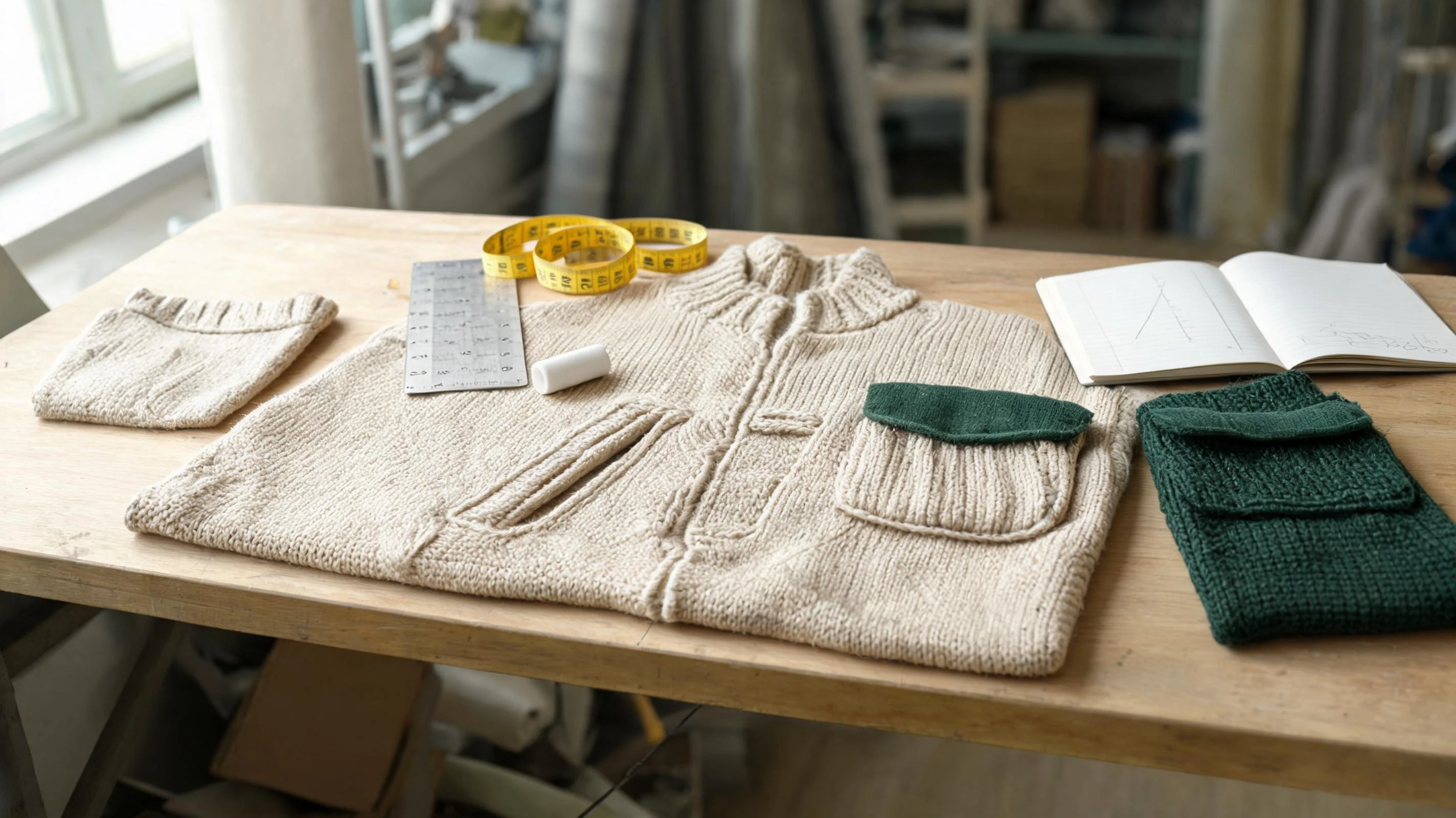
Three pockets, one body: a patch pocket sewn on, a welt opening worked into the panel, and a flap knitted from a darker yarn on the same gauge.
Pockets are the part of a knitted garment where design and manufacturing stop agreeing. A designer draws a line on a chest; the machine room reads that line as either a program, a cut or a seam. The buyer sees the same line in three seasons of samples and never learns which of the three it was — until the wash test, when the pocket mouth has opened by six millimetres and nobody can say why.
This note takes the five pocket constructions we are asked for most on women's knitwear and asks the same four questions on each: how it is made, where the cost sits, where it fails in bulk, and what we need from you before we can quote it honestly.
What the trade is showing, and why it matters here
The product story going round the knitting trade press this month is a hydration vest knitted in one piece, with every pocket built into the fabric itself: no cutting, no sewing, ready to wear off the machine. From the other end, the machine builders are pushing the same idea — Cifra has been presenting what it calls a fourth dimension of warp knits, and the flat-knitting halls this season have been selling integrated structures rather than faster panels.
We cannot run a one-piece technical vest on the machines that make a 12GG merino cardigan, and we will not pretend otherwise. But the direction is right, and it explains the argument of this article: on a knit, a pocket is a structural decision. Every pocket that is knitted rather than sewn removes an operation, a bag and a failure point — and adds a programming problem and a minimum width. That is the trade you are making, and it should be made at the flat drawing, not at the sample.
One: the pocket knitted into the panel
The opening is worked on the machine, with a rib or a links edge, and the bag is joined behind it — either knitted as a second panel or cut from a light tricot. Nothing is cut in the body, so no yarn in the panel is severed and nothing runs. This is the cleanest pocket a knit can have, and the only one where the mouth will not go soft, because the edge is knitted rather than folded.
Where the cost sits: the program. The pocket mouth has to be placed in the needle bed, which means the panel width, the pocket width and the pocket position are decided before the first panel is knitted. Change the pocket 2cm wider for a larger size and it is a new program, not a new line on a spec sheet. On a simple style, that programming is a few hundred yuan once; on a style with three sizes and two pocket positions, it is four programs.
Where it fails in bulk: a mouth that has been programmed too narrow to take a hand, and a bag that is too shallow so the phone sits on the welt and pulls it out of shape. Both are geometry errors made once and repeated 300 times.
What we need from you: finished pocket width and depth, the height of the mouth from the hem, and whether the opening is vertical, horizontal or angled. On a fully-fashioned panel, also tell us whether the pocket edges up to a side seam — that decides whether the bag can be closed in the seam or needs its own seam allowance.
Two: the patch pocket, sewn on afterwards
A separate knitted panel, edges finished, sewn onto the body. It is the most flexible pocket in design terms — any shape, any position, cheap to sample — and the one most likely to pucker.
The reason is shrinkage. A patch pocket is a second piece of knitting, and if it was knitted from a different yarn lot, on a different machine setting, or left to relax for a different length of time before sewing, it will shrink differently from the body in the first wash. The body pulls the pocket, or the pocket pulls the body, and no amount of pressing fixes it. Our rule is that the pocket is knitted from the same yarn lot, at the same gauge and stitch count, and relaxed alongside the body before either is sewn.
Where the cost sits: an extra panel and an extra making operation, plus hand-guided topstitching if the shape is curved. Where it fails in bulk: puckering after wash; corners that curl because the corner has no rib and the knit rolls; and the top edge sagging on a heavy pocket sewn onto a soft 16GG body — the fix there is a small fused strip behind the top edge, which has to be planned into the pattern.
What we need from you: the finished shape and its corner radius, the depth of the top hem, whether the pocket is functional or decorative, and whether the topstitching is visible. A visible topstitch on a coarse gauge is a design statement; an invisible one on the same gauge is nearly impossible, and we will say so.
Three: the welt or slit opening
A slit cut into the panel and bound, with a bag behind. On woven fabric this is routine. On a knit it is a decision about the gauge: at 16GG on a dense jersey, a bound slit works and is what most fine-gauge dresses use. At 3GG or 5GG on a brushed yarn, a cut slit is a hole with a cut yarn on each side of it, and it will travel.
So on a coarse knit, the welt either becomes a knitted opening (see the first pocket above) or it gets stabilising: a fused strip or a narrow tape behind the mouth before it is cut, then binding through all of it. That is a real cost — tape, a fusing step, a binding operation — and it changes the hand of the pocket mouth slightly, which is worth knowing before you approve the sample.
Where it fails in bulk: the mouth "smiling" — opening wider at the middle than at the ends, because the knit behind it has relaxed; and the ends of the slit tearing outward after a season of hands going in. Both are visible from two metres away, which is the worst kind of failure.
What we need from you: gauge of the body, the finished mouth length, whether there is a bartack or a bar of small stitches at each end, and whether the pocket is angled. An angled welt on a knit needs a program, not just a cut.
Four: the flap, a small panel that has to behave like a woven
A flap is a double-layer knitted piece expected to hang flat and stay square, which is asking a knit to do the one thing it does not do. Two things make it work: knit the flap denser than the body — a tighter stitch count, sometimes a slightly finer gauge — and keep it small. A long flap on a soft yarn will curl at the corners whatever we do.
Where the cost sits: a second small panel, a turning and pressing step, and a closure — a stud, a button or a hidden press. Where it fails in bulk: the flap shrinking at a different rate from the body and no longer covering the mouth; corners curling after washing; and the closure pulling through the flap's own knit if the stud was sized for a woven.
What we need from you: flap depth and width, whether it is functional or decorative, the closure type, and whether the flap is lined or double-faced. If the flap carries a logo, tell us early — embossing a knitted flap is a different operation from embossing a leather one, and often the answer is a woven label on the underside.
Five: the pouch, one wide pocket carrying weight
The kangaroo or pouch pocket on a cardigan, coatigan or hooded knit: one wide panel across the front, often with hand-warmer openings at the sides. It reads as the simplest pocket on this list and it is the heaviest.
Two technical facts decide it. First, the pocket doubles the fabric across the whole span, so it takes roughly twice the yarn of a patch pocket and adds weight exactly where the garment hangs from the shoulders. Second, the hand-warmer openings are cut or knitted into the pouch, and if they are cut, both the pouch and the body behind them need finishing at that edge or they will roll apart within a month.
Where the cost sits: yarn, and the sewing across a wide span — a pouch is one long seam that has to stay straight while the body relaxes around it. Where it fails in bulk: the pouch sagging away from the body when it is loaded; the side openings rolling open; and the bottom edge of the pouch pulling the hem out of level.
What we need from you: finished width and depth, whether the side openings exist, and what the pocket is expected to carry. A pouch designed for hands and a pouch designed for a phone and keys are different patterns.
The pocket bag, which nobody draws
The bag is the part of a pocket that is never in the sketch and always in the quote. Three options: a knitted bag on the same yarn — invisible, doubles the yarn cost, stretches with use; a tricot or woven bag — cheap, keeps its shape, and needs a seam allowance that will not print through the body; or no bag at all, with the pocket opening into a doubled panel, which is what a decorative flap pocket usually is.
Our default on women's knitwear is a light tricot bag on anything that will hold a phone, and a knitted bag only on fine-gauge styles where a woven bag would show. If your reference garment has a bag you can turn out and read, send a photo of it — it tells us the answer in one look.
The five, side by side
| How it is made | Cost driver | Where it fails in bulk | |
|---|---|---|---|
| Knitted into the panel | Opening worked on the machine, bag joined behind | Programming, plus a program per size and position | Mouth too narrow to use; bag too shallow and pulling on the welt |
| Patch | Separate panel, finished edge, sewn on | Extra panel, extra operation, hand-guided topstitch | Puckering after wash; curled corners; sagging top edge |
| Welt or slit | Cut and bound, stabilised on coarse gauges | Tape, fusing step, binding, bartacks | Mouth smiling open; slit ends tearing outward |
| Flap | Double-layer panel knitted denser than the body | Second panel, pressing, closure | Flap shrinking off the mouth; corners curling; stud pulling through |
| Pouch | One wide panel with finished side openings | Yarn for double thickness, long seam | Sagging when loaded; openings rolling; hem pulled out of level |
What a pocket does to grading
On a woven garment a pocket is graded like any other piece of the pattern: scale it, keep the corner radius, move on. On a knit there are two different problems. On a knitted-in opening, every size with a different pocket position or width is a separate machine program, so the cost of the pocket multiplies by the size range rather than sitting flat. On a sewn pocket, the panel is graded, but the placement has to be checked against the shaping: a pocket that sits correctly on the waist of a size S can end up on the hip of an XL, because a knit's waist does not move in a straight line down the size run.
The practical consequence is a rule we apply at quotation: a pocket position is given as a measurement from a fixed point — the hem, the centre front or the shoulder — and checked against every size in the range before the pattern is released. It is a fifteen-minute check that saves a size run of samples.
What to send with a pocket enquiry
- The flat with the pocket dimensioned. A line on a chest is not a specification. Width, depth and the height of the mouth from the hem are.
- A photo of the inside of the pocket. Bag material, how it is closed, whether there is tape behind the mouth: all three are visible in one photo and invisible from outside.
- The gauge of the body. It decides which of the five constructions is even possible; a welt on a 3GG brushed yarn is a different project from a welt on 16GG jersey.
- What the pocket has to carry. Hands, a phone, a purse, or nothing at all. A decorative pocket can be knitted light and sewn cheap; a working one cannot.
- Whether the pocket is the design. If it is, we will spend the money on the mouth, the corners and the stitching. If it is not, we will make it disappear.
Where the IP line sits on pockets
Pocket construction itself is open. A patch pocket, a welt, a flap and a pouch are methods that belong to nobody, and using the same construction as a reference garment is not copying.
What is not open:
- A registered pocket shape or flap profile. Some pocket and flap shapes are registered designs. We will not reproduce one, and we would rather say that at quotation than at second sample.
- A pocket that carries someone else's mark. An embossed logo on a flap, a branded zip on a pocket, a stamped stud on a patch: those are trademarks, and we produce yours, never another brand's — including when the reference sample came from a market stall.
- Trade dress. Pocket shape, stitching line, trim colour and label position together can read as one brand even when each part is generic. This is the one that catches buyers out, because every individual element is free to use.
Our practice is a documented re-development. When we rebuild a pocket for your yarn, your gauge and your size range, we record what changed and why, and it goes into the order file with the approved sample. Two seasons later, if a design claim arrives, that file is the answer — and it also lets you move the style to a second supplier without losing the reasoning behind it.
Three questions before the pocket is drawn
Will a hand actually go into it, at the size the customer is? Is the body under it stable enough to carry the pocket, or will the pocket end up holding the garment together? And does the pocket need to be a line at all, or is the style better with a seam, a rib band or nothing? In our experience the cheapest pocket is the one that was decided at the same time as the silhouette — and the most expensive is the one added after the first sample was approved.
How pockets run through the floor
A pocket is decided in design, programmed in the pattern room and made on the finishing line:
- Design development — the pocket construction is chosen against gauge and yarn weight before the quotation, not after the sample.
- Pattern and sampling — mouth position, bag depth and program are set in the pattern, and the first sample is knitted with the real bag inside it.
- Production and finishing — setting, pressing and inspection decide whether the mouth is still level when the garment is packed.
Our standard sequence: quotation within 48 hours of a usable pack, tech pack and yarn in 3–5 days, first sample in 7–10 days per round, bulk at 45–55 days after approval, at 300 pieces per style per colour, FOB Shenzhen or Guangzhou, full inspection to AQL 2.5.
Three questions we get asked
Can a pocket opening be knitted in without cutting?
Yes, on flat knitting it is one of the cleanest things a machine can do: the mouth is worked with a rib or links edge and the bag is joined behind it. The constraints are that the width and position are fixed in the program, and that a program is needed per size and per position. Above four or five sizes, that is the cost to compare against a sewn pocket.
Why does a patch pocket pucker after the first wash?
Almost always because the pocket and the body relaxed differently before they were sewn — different yarn lot, different machine tension, or the pocket was cut and sewn the same day it was knitted. The fix is boring and it works: same lot, same gauge, relax both together, stabilise the top edge, and wash-test one garment before bulk.
Does adding a pocket change the MOQ?
Not directly. Our minimum stays at 300 pieces per style per colour. What changes is the setup: a knitted-in pocket means a program per size, and a patch or flap pocket means an extra panel and an extra operation. On a first order of 300 pieces those are real numbers per unit, which is why we quote the pocket separately rather than folding it into the garment price.